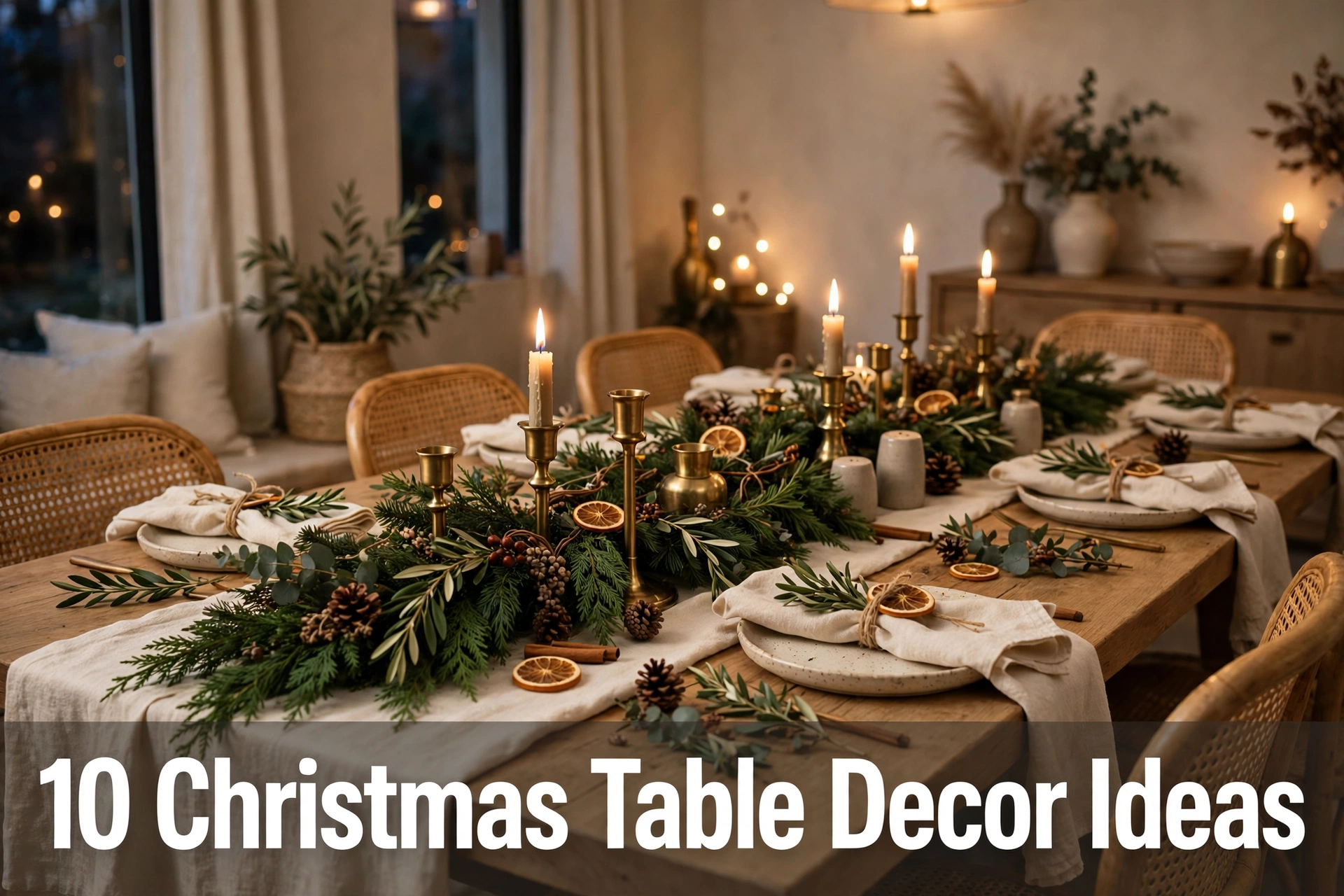
10 Christmas Table Decor Ideas
Introduction: A Natural and Elegant Christmas Table
A Christmas table does not need to be crowded to feel festive. The tables guests remember are ones where they could eat comfortably, talk easily, and reach for food without moving a decoration out of the way. Natural and elegant tables use a small number of materials well: greenery, wood, linen, glass, and warm light, repeated in a clear pattern.
This guide covers how to choose a palette, build a centrepiece that does not block conversation, set places with enough elbow room, add natural garland safely, use candles with care, and adapt the same ideas for a small table and for a large gathering. It is written for homeowners and renters, for small spaces and for real budgets, and most ideas use items you may already own.
The key test for every choice is simple. If an item makes it harder to sit down, eat, talk, or clear plates, it does not belong on the table, no matter how pretty it looks in a photograph.
Choosing a Palette
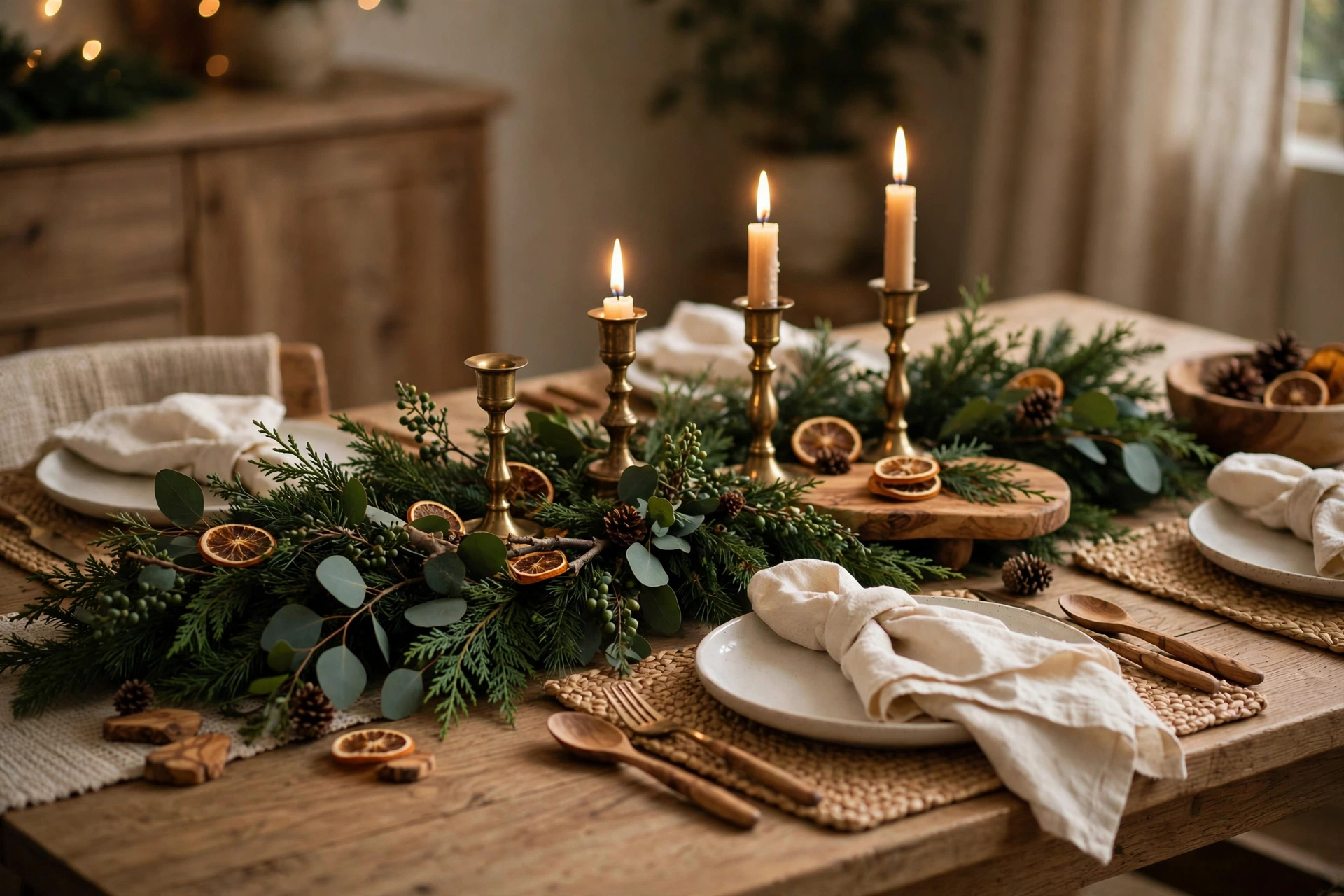
Start with three colours, not six. A clear palette keeps a natural table calm and makes shopping and gathering items from around the house much easier.
A classic natural palette is deep green, cream, and warm brass or wood. Deep green comes from fresh or faux greenery. Cream comes from linen, candles, and plain plates. Brass or wood comes from candlesticks, a wooden board, or flatware. This palette works with red accents if you want a traditional look, but red should stay as the smallest colour, for example in a ribbon, a few berries, or napkins, rather than competing with the green and cream on every place setting.
A softer palette is sage green, white, and pale wood, with touches of silver or frosted glass. A moody palette is forest green, burgundy, and antique gold, with dark wood, but keep the cloth or runner light enough that plates stay visible at night.
Once you choose a palette, repeat it in at least three places: the centrepiece, the napkins or place cards, and one other detail, such as a garland on a sideboard or a bowl of ornaments.
For renters and small budgets, build the palette around what you already own. Plain white or cream plates, clear glasses, and a neutral runner can carry almost any seasonal palette. Change only the napkins, the greenery, and one centrepiece item.
Centrepiece Options
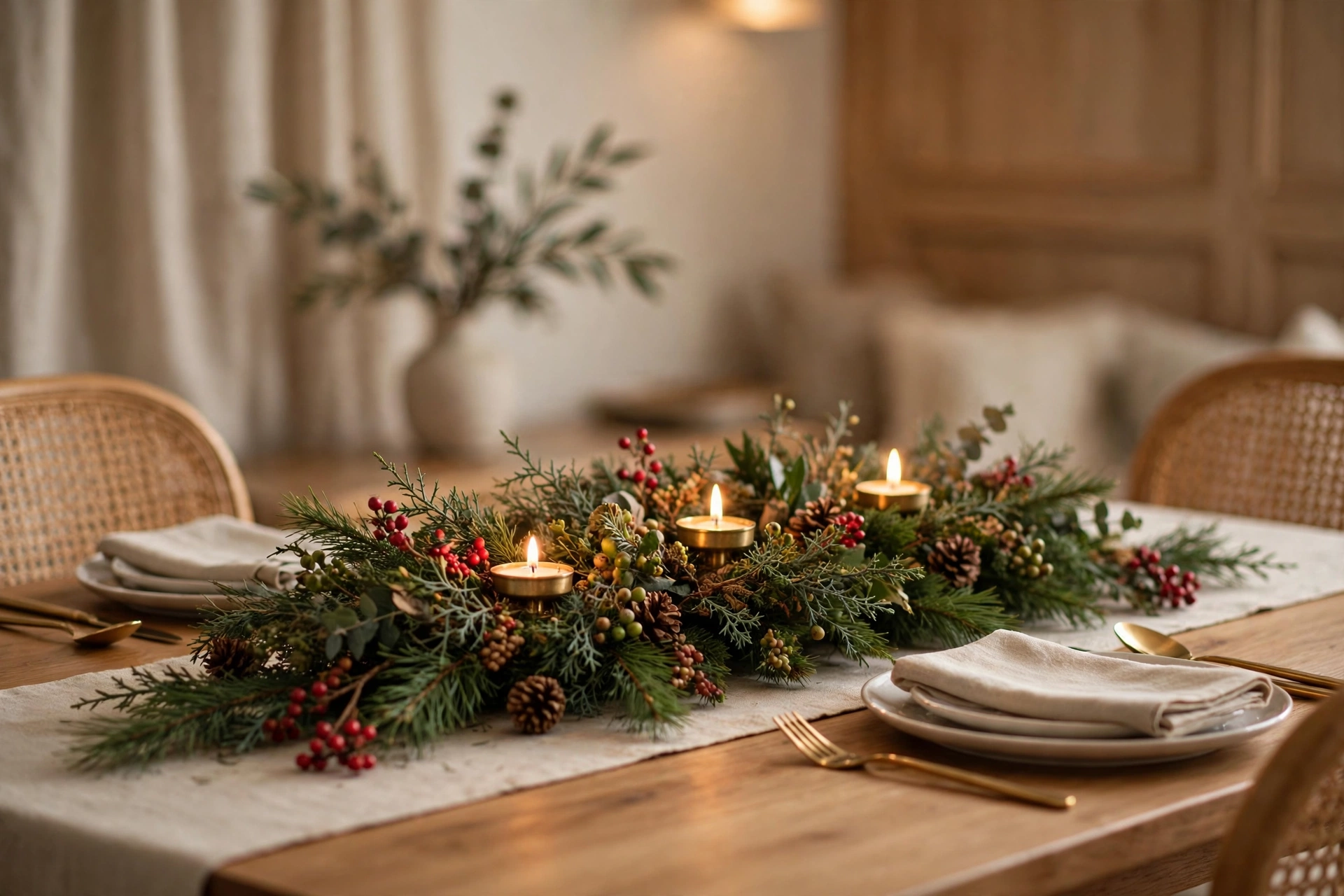
A centrepiece should sit low, or sit high and narrow, but it should not sit at eye level across the middle of the table. Guests need a clear sightline to talk.
For conversation, keep a low centrepiece under 12 inches high. This includes a shallow bowl of greenery, a low wooden board with candles in short holders, a row of small vases with short stems, or a garland laid flat along the centre of the table. A low centrepiece works on almost every table, including a small table, because it leaves the space above it open.
A tall centrepiece can work if it is narrow and open. A tall candlestick, a slim vase with a few long branches, or a tall lantern with an open frame can rise above eye level, usually above 24 inches, while still letting guests see around it. Avoid a tall, wide arrangement, such as a large bouquet in a wide vase, in the centre of a table where people sit opposite each other. It will block faces and force guests to lean around it.
For a rectangular table, use one long centrepiece, or a repeated series of three smaller centrepieces, rather than one large round arrangement in the middle. A garland that runs the length of the table, with candles and small ornaments spaced along it, is one of the most practical options. It fills the centre without taking up plate space, and it can be shortened or lengthened to fit the table.
For a round table, use one compact central arrangement, such as a single bowl, a small cluster of candles, or a short garland ring, rather than a large display.
Practical centrepiece ideas include: a wooden board or tray with three pillar candles of different heights, surrounded by pine, eucalyptus, or rosemary sprigs, which also contains wax and needles for easier clearing; a row of small glass vases, each with two or three stems, spaced evenly along the table, which guests can move if they need space; a low, wide bowl of pinecones, dried orange slices, cinnamon sticks, and a few small ornaments, with a candle in the centre; and a simple flat garland with battery candles or short candlesticks on a heat safe tray, which is easy to lengthen or shorten for a long table.
For a more formal table, add one metallic detail, such as brass candlesticks or a gold charger under each plate. Use one metallic finish, repeated, rather than three different finishes on the same table.
Place Settings: Width, Spacing, and Layout
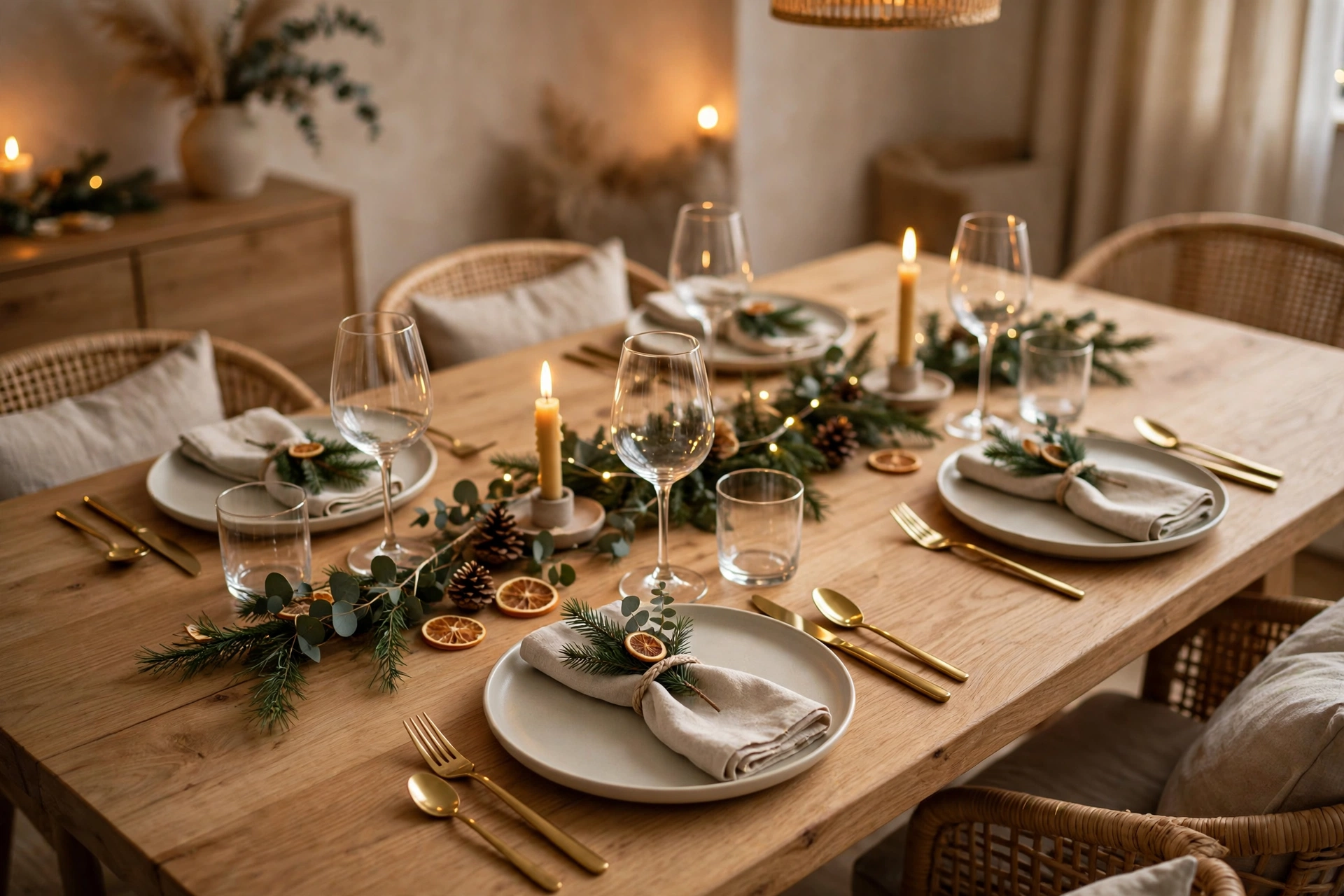
Comfort at the table starts with width. Allow 24 to 30 inches of table width per guest, measured from the centre of one place setting to the centre of the next. For a relaxed meal with serving dishes on the table, aim for the higher end, 28 to 30 inches. For a tighter table, 24 inches is the minimum that still lets guests use a knife and fork without bumping elbows.
Table size guides help with planning. A 48 inch round table usually seats 4 guests comfortably. A 60 inch round table usually seats 6 to 8 guests, depending on how much serving space is needed. A rectangular table that is 72 inches long and 36 inches wide usually seats 6 guests, 3 on each side. A rectangular table that is 96 inches long and 42 inches wide usually seats 8 to 10 guests. If your table is smaller than these guides, plan to serve food from a sideboard or kitchen counter, rather than crowding every dish onto the table.
Place setting layout, from left to right, follows a simple order. Forks go on the left of the plate, knives on the right with the blade facing the plate, and spoons to the right of the knives if needed. Water glasses go above the knife, slightly to the right. Wine glasses, if used, go to the right of the water glass. Keep glasses about 1 inch from the tip of the knife, so they are easy to reach and less likely to be knocked over.
Plate spacing matters as much as glass spacing. Leave at least 2 inches between the edge of one plate and the edge of the next plate where possible. This gives room for a bread plate, a napkin, and a hand resting on the table. If plates are touching, the table will feel crowded even before food is served.
Napkins can be placed on the plate or to the left of the forks. A cloth napkin in the chosen palette, tied with a sprig of rosemary, a cinnamon stick, or a thin ribbon, adds a festive detail without costing much. Good quality plain paper napkins are also fine for a large gathering.
Place cards are useful when guests do not all know each other. Keep them low and flat. Chargers can make a table look finished, but they take up space, so use them only if the table is wide enough. On a narrow table, skip chargers.
Natural Garland and Greenery

Greenery is the easiest way to make a Christmas table feel natural and seasonal, and it is also one of the most forgiving materials. Fresh pine, fir, cedar, eucalyptus, olive branches, and rosemary all work on a table, and they can be mixed, but it is better to use two types of greenery well than five types in a tangled pile.
For a table runner made of greenery, start with a base of one type, such as pine or fir, laid in overlapping sections along the centre of the table. Add a second type, such as eucalyptus or cedar, in smaller sprigs on top, to add texture and a different shade of green. Keep the garland flat and narrow, about 6 to 8 inches wide, so it does not push into plate space. Trim any branches that hang over the edge of the table or touch plates.
Fresh greenery will dry out in a warm room. To keep it looking fresh for a meal, assemble the garland on the day of the meal where possible, or the evening before, and keep it in a cool room until you set the table. Mist it lightly with water, and keep it away from radiators, fireplaces, and direct heat. If you are using fresh greenery with candles, place candles on a tray or plate, and keep greenery at least 12 inches away from an open flame, or use battery candles inside the garland instead.
Faux greenery is practical for renters, for tables set days in advance, and for homes with allergies. Choose varied shades and textures, and bend branches so they lie flat. Mix in one or two sprigs of fresh rosemary or eucalyptus for scent.
A fabric runner is usually 12 to 14 inches wide for a standard dining table. A runner wider than 16 inches on a 36 inch wide table will leave very little room for plates. If you do not want a fabric runner, a greenery garland can act as the runner itself, laid directly on the table or on a narrow board, with serving dishes kept on a sideboard.
Other natural details include pinecones, dried orange slices, cinnamon sticks tied in small bundles, and wooden beads. Use them in groups of three or five along the garland, rather than scattered randomly.
Candles and Lighting Safety
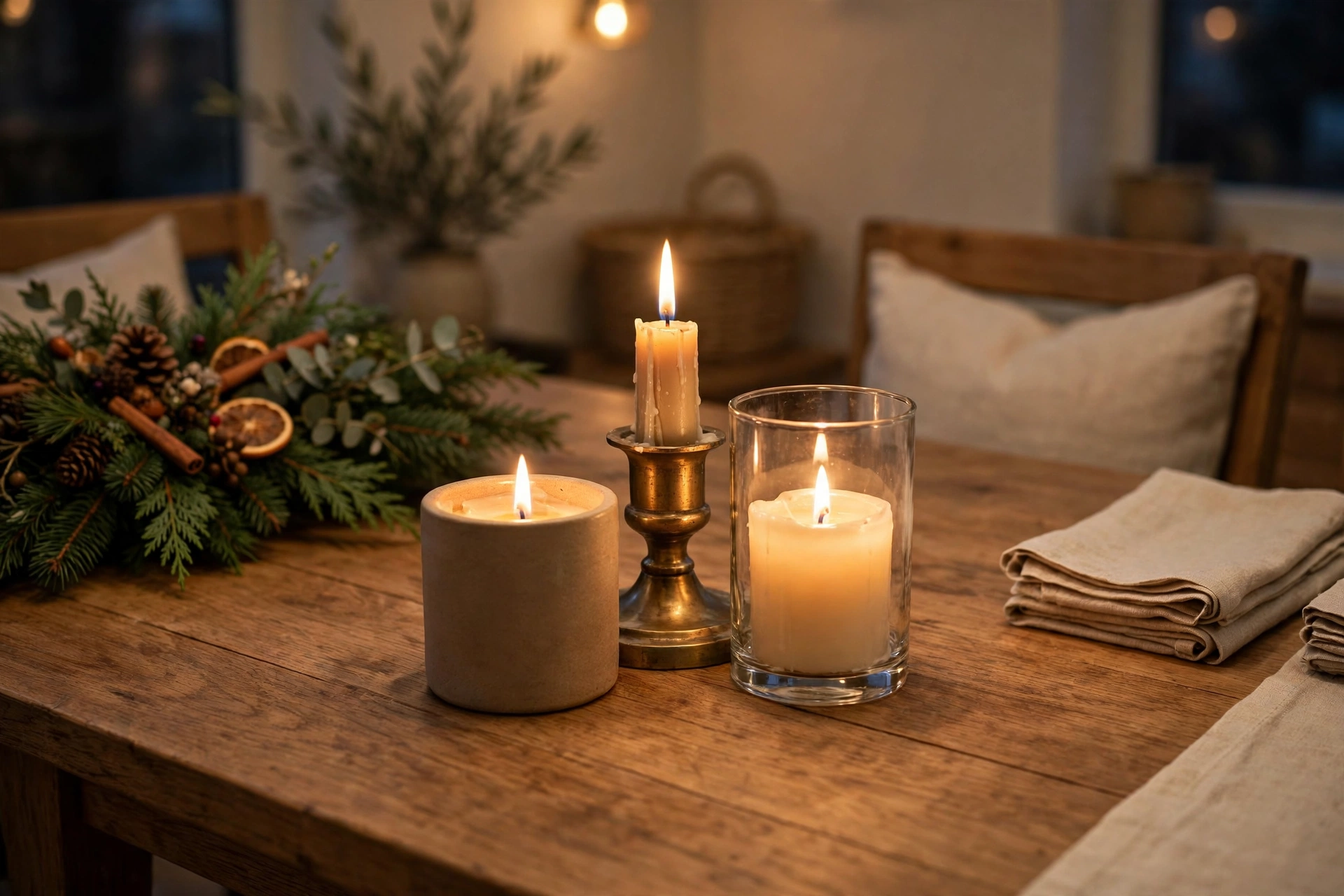
Candles create the warm light that makes a Christmas table feel special, but they need clear safety rules, especially when greenery, fabric, and paper are on the same table.
Use candles in stable holders, on a tray or plate, and never directly on a fabric runner or on loose greenery. Pillar candles need a plate or tray underneath to catch wax. Taper candles need a holder that fits the candle snugly, so it does not lean. Tea lights need a glass holder, not an open metal cup on fabric.
Candle heights should be planned with the centrepiece height rule in mind. Short pillar candles, 3 to 6 inches high, work in a low centrepiece and keep light close to the table. Tall tapers, 10 to 12 inches high, work in a tall, narrow centrepiece, but they should be placed where guests will not reach across them. Avoid candles at eye level in the centre of the table, where they can block views and get knocked over.
Keep an open flame at least 12 inches away from greenery, fabric, paper, and decorations, and at least 12 inches below any hanging decoration. Do not place candles under a low hanging light, a garland draped from above, or a tall arrangement that could catch heat. Never leave candles burning unattended, and never leave them burning when guests leave the table for a long period.
Battery candles are a good choice for a table with children, pets, or a lot of greenery. They can be placed inside a garland or lantern without a fire risk. Use real candles on a sideboard or mantel if you want real flame in the room without risk on the table.
For the whole room, dim the main ceiling light and let table candles, a corner lamp, and tree lights provide the main light, while keeping at least one soft lamp on so guests can see food clearly. Aim for warm white light, around 2700K, which flatters wood, green, cream, and brass.
Small Table Ideas
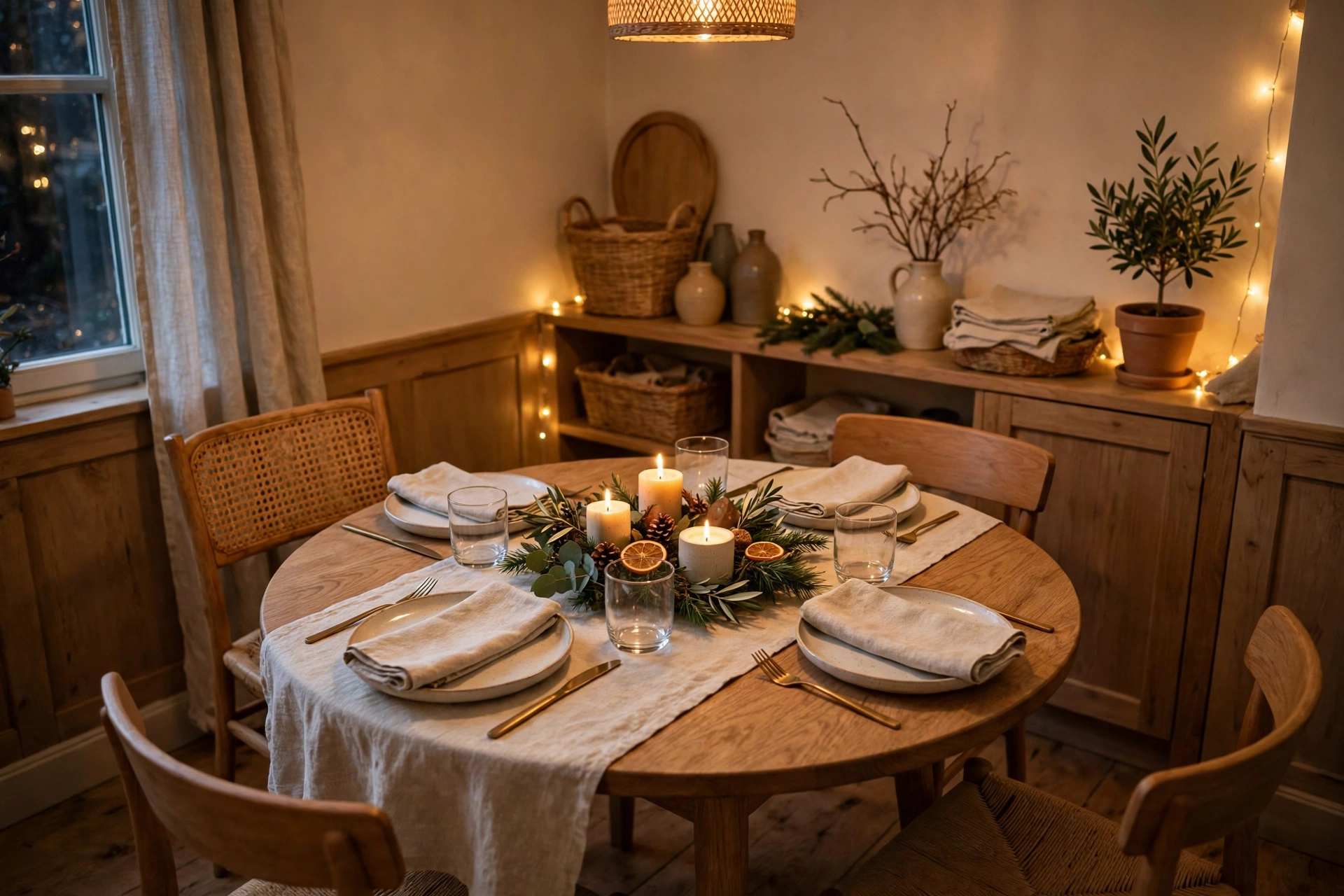
A small table needs a different approach, not just a smaller version of a large table. The goal is to keep the table usable, and to move as much as possible off the table.
For a table for 2 to 4 guests, use one small centrepiece only. A single candle in a glass holder, a small vase with three stems, or a short sprig of greenery on a small board is enough. Do not add a long garland, a large bowl, and candles all at once. Choose one focal point, and let the plates, glasses, and napkins provide the rest of the colour.
Serve food from the kitchen or a sideboard, and keep only water, one shared dish, or a small bread basket on the table. A sideboard or kitchen counter can act as a serving station.
Use a narrow runner, or no runner at all, on a small table. A table that is 30 to 36 inches wide has very little room to spare, so use place mats instead of a runner, or a greenery sprig at each place setting.
Fold napkins simply, and skip chargers, large place cards, and extra glasses. A water glass and one wine glass, if used, are enough, with extra glasses kept on the sideboard.
Table for Large Gatherings
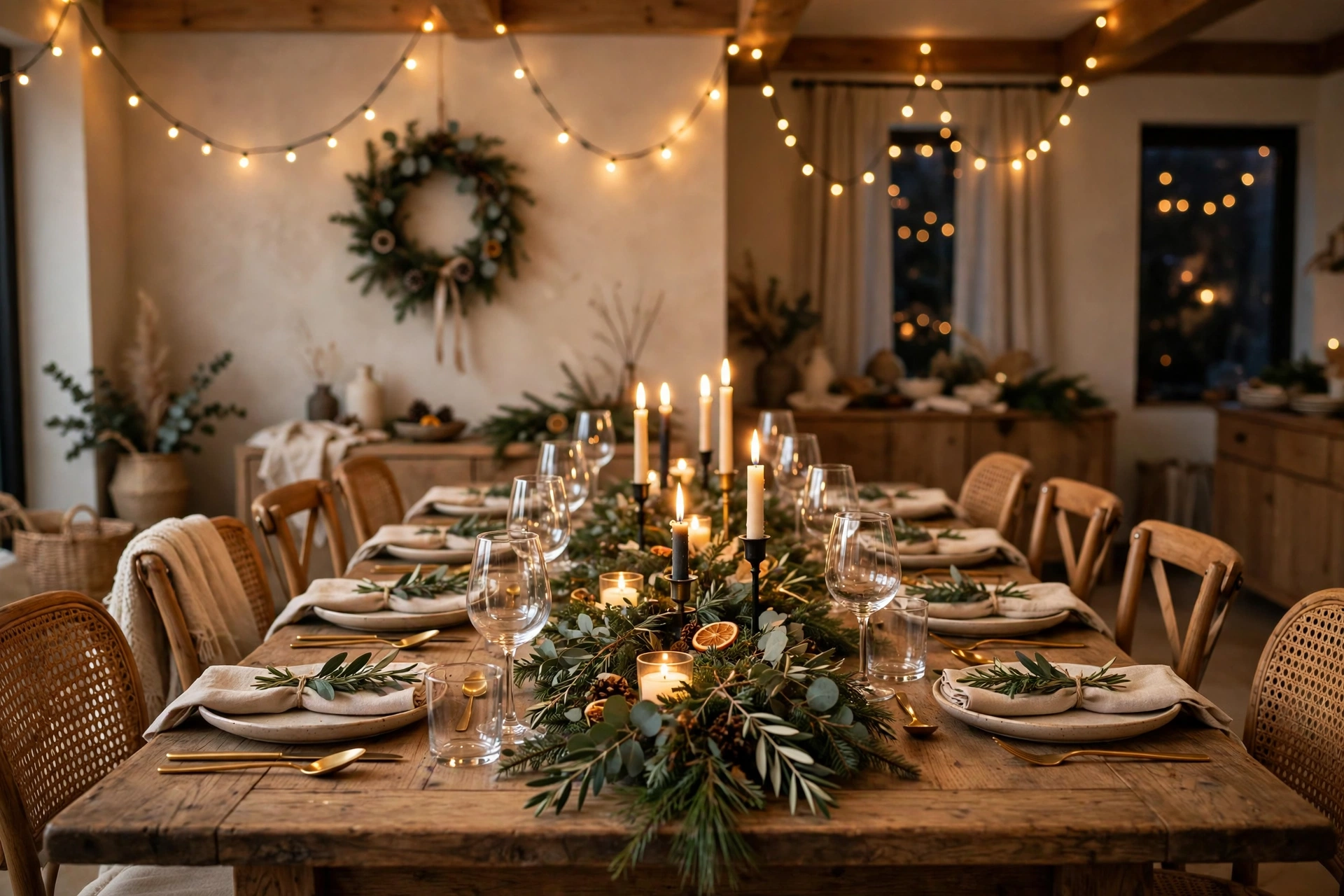
A large gathering needs planning for seating, serving, and clearing, not just decoration. Start by counting guests and measuring the table, or tables, before choosing a centrepiece.
If one table is not large enough, use two tables pushed together, or a main table plus a separate children’s table or a buffet table. Two tables pushed together need a runner or garland that runs across the join, so the join does not look like a gap. A buffet table, set up on a sideboard or a folding table, lets guests serve themselves and keeps the main table clear for eating and conversation.
For a large table, repeat the centrepiece rather than making one huge arrangement. Three identical low arrangements, spaced evenly, look more elegant, are easier to move, and let guests see across the table between them.
Place settings for a large gathering should be simpler, not more elaborate: plain plates, clear glasses, and one napkin detail. Serve main dishes from a sideboard, salads and sides on the table in shared bowls, and desserts from the kitchen when needed. Label dishes for dietary needs, such as vegetarian, gluten free, or nut free, with a small card next to each dish on the sideboard.
What to Avoid
Some Christmas table ideas look good in photographs but cause problems at a real meal. Avoid a centrepiece taller than 12 inches and wider than 12 inches where guests sit opposite each other, strong scented candles on a dining table (use unscented candles there, and save scented candles for a hallway or bathroom), glitter, fake snow spray, and loose tinsel (they get onto plates and food; use glass ornaments, metallic holders, or a beaded garland instead), too many colours and patterns at once (choose one pattern, such as a striped runner, and keep everything else plain), decorations covering all serving space, and non food safe items touching food (keep painted pinecones and loose paint ornaments in the centrepiece, on a tray, away from serving dishes).
Step by Step Setting Order
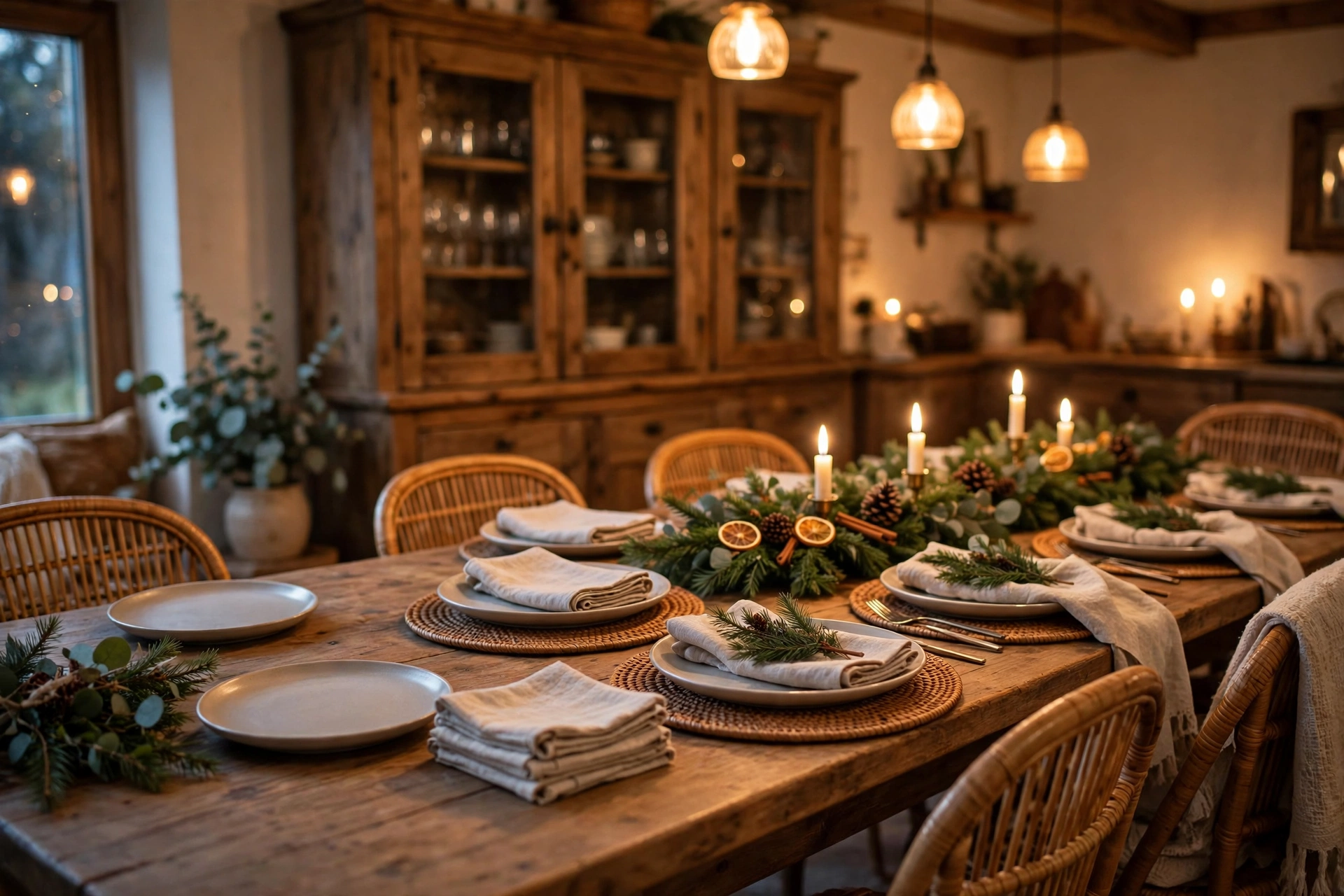
Setting a table in a clear order saves time and avoids moving decorations twice. Use this order for a Christmas meal.
Step 1: Clear and clean the table, count guests, check table width, and decide if food will be served from the table or from a sideboard. Step 2: Lay the tablecloth or runner evenly. A runner should hang about 6 to 12 inches over each end of a rectangular table, or sit flat with no overhang if the table is small. Step 3: Place the centrepiece and garland, sit in a chair on each side, and check that you can see the person opposite you. Adjust height now, not after plates are set. Step 4: Set plates, flatware, and glasses, leaving 24 to 30 inches per guest and at least 2 inches between plates. Step 5: Add napkins and place cards, if used, keeping them low and simple. Step 6: Add candles in holders and on trays, check clearances from greenery and fabric, and light candles last, just before guests sit down. Step 7: Add final natural details in groups along the garland, step back, and remove one item if the table looks crowded. A table that looks slightly simple before guests arrive will look full once food, glasses, and people are added.
Budget Planning

A Christmas table can be beautiful at many budgets, because the most important elements, greenery, light, and clear spacing, do not need to be expensive.
A low budget table can use plain white plates and clear glasses you already own, a linen or cotton runner in cream, fresh or faux greenery from a garden, a small vase or candle as a centrepiece, and cloth napkins tied with rosemary or twine. If you need to buy one item, make it a set of candles in stable holders, because light changes the whole table.
A moderate budget table can add brass candlesticks, a matching set of napkins, a tablecloth, or a set of chargers. Choose one of these to invest in, rather than buying all of them at once.
A higher budget table can include a large fresh garland, a set of quality linen napkins, a new tablecloth in a natural colour, or a set of matching brass holders.
Keep costs down by using a single palette, borrowing or reusing items from last year, and by buying greenery from a garden centre, market, or your own garden where possible. Avoid buying matching sets for every guest, unless you plan to reuse them for many years.
Frequently Asked Questions
How much space does each guest need at a Christmas table?
Allow 24 to 30 inches per guest. For a relaxed meal with serving dishes on the table, use 28 to 30 inches. For a tighter table, 24 inches is the minimum.
What height should a Christmas centrepiece be?
Keep a low centrepiece under 12 inches high for easy conversation, or use a tall, narrow centrepiece above 24 inches, with an open shape that lets guests see around it.
Are real candles safe with fresh greenery?
Real candles can be used safely if they are in stable holders on trays, kept at least 12 inches away from greenery and fabric, and never left unattended. Battery candles are safer for a table with children or a lot of greenery.
How can I decorate a small Christmas table?
Use one small centrepiece, serve food from a sideboard, use place mats instead of a wide runner, and skip chargers and extra glasses.
What is the easiest centrepiece for a beginner?
A low tray with three pillar candles of different heights, surrounded by pine, eucalyptus, or rosemary sprigs, is easy, safe, and easy to move.
Conclusion
A beautiful Christmas table is not the fullest table, it is the table where guests can sit, eat, talk, and enjoy the meal without moving decorations out of the way. Choose a simple palette, keep the centrepiece low or narrow, give each guest enough room, use greenery and candles safely, and set the table in order. Those choices work for a table for two, a family table for eight, and a large gathering with a buffet.
Start with what you already own, add greenery and light, and keep the table clear enough for food and conversation. A natural, elegant Christmas table does not need to be perfect to feel special, it needs to feel welcoming, calm, and ready for guests.