
12 Whimsy Christmas Decor Ideas
Whimsy Christmas decor is Christmas decor with a sense of play. It keeps the familiar shapes of the season, the tree, the garland, the table, the window, and the entry, but it loosens the rules. Colours are brighter, patterns mix more freely, ornaments do not all match, and a room is allowed to look joyful rather than perfectly styled. Whimsy is not clutter for its own sake. It works best when one clear idea holds the room together, and the playful details sit inside that idea.
This guide explains that idea in practical terms. It covers how to choose a palette, how to decorate a tree, a mantel, a table, windows, and an entry, and how to adapt the look for a small space. It also covers what to avoid, a decorating order that saves time, and a budget plan that keeps the look under control. The advice is written for homeowners and renters, for small spaces and real budgets, and for rooms that will actually be lived in through December.
What Whimsy Christmas Means, and What It Does Not Mean

Whimsy Christmas is often described as playful, colourful, and a little nostalgic. In practice, it has four traits. First, colour leads. A whimsy room usually has one bright anchor colour, such as cherry red, candy pink, or deep teal, plus one or two softer colours to balance it. Second, pattern mixes. Stripes, dots, gingham, and simple florals can sit together if they share at least one colour. Third, scale varies. One oversized bow, one large ornament, or one tall candy cane can make a room feel playful, while many small pieces at the same size can make it feel busy. Fourth, handmade and collected pieces matter more than matching sets. A paper chain, a felt garland, a child’s ornament, and a vintage bauble can belong together if the palette is consistent.
Whimsy does not mean every colour at once, every pattern at once, or every surface covered. A room with no resting place for the eye feels tiring, not festive. The test is simple. Stand at the doorway and look for one focal point, usually the tree, then for two or three supporting details that repeat its colour or shape. If every surface competes for attention, remove one layer, not one colour.
How to Choose a Colour Palette

Start with the room you already have, not with a shop display. Note the wall colour, the sofa colour, the floor, and the largest rug. A whimsy palette should sit well with those fixed pieces, because they will not change for December.
Use a 60, 30, 10 ratio as a planning guide. About 60 percent of the visible decor should be the main colour, usually a neutral or a deep green from the tree and garland. About 30 percent should be the supporting colour, such as cream, blush pink, or soft gold. About 10 percent should be the accent, the bright or playful colour that makes the look feel whimsy, such as cherry red, candy cane stripes, or a bold pink.
Three palettes work well in most living rooms:
1. Classic whimsy: deep green, cream, and cherry red, with candy cane stripes as the accent pattern. This is the easiest palette for a first whimsy room, because most ornaments, ribbons, and wrapping paper already come in these colours.
2. Pink and gold whimsy: blush pink, cream, and soft gold, with a little deep green from the tree. This palette suits a light room, a white or cream sofa, and a smaller tree, because pink reads as playful without feeling loud.
3. Woodland whimsy: deep green, warm brown, cream, and one bright accent, such as mustard yellow or berry red. This palette suits a room with wood furniture, baskets, and natural textures, and it pairs well with pinecones, dried orange slices, and wooden ornaments.
Choose one palette for the whole living area, and repeat it in the tree, the mantel, and the table. A different palette in each corner is the fastest way to make a whimsy room feel messy. If you love two palettes, use one for the living room and the other for a bedroom or a kitchen, not both in the same sightline.
Whimsy Christmas Tree Ideas

The tree is the anchor of a whimsy room, so it deserves the most planning and the least rushing. The steps below work for a real tree and for an artificial tree, with one difference noted for a real tree: keep it watered, keep it away from heat sources, and check the water level daily.
Choose a size that fits the room. Measure the ceiling height, then subtract at least 30 centimetres, or about 12 inches, for the topper and for clearance. A 1.8 metre tree, about 6 feet, suits a standard living room with a ceiling around 2.4 metres, or 8 feet. In a small apartment, a 1.2 to 1.5 metre tree, about 4 to 5 feet, or a slim profile tree, gives the same festive effect without blocking a walkway. Measure the floor space too. A full tree needs a diameter of about 1.1 to 1.3 metres at the base for a 1.8 metre tree. A slim tree needs about 0.8 to 0.9 metres.
Lights go on first, and they set the whole look. For a full glow, use 100 to 150 lights per foot of tree height. That means a 6 foot tree needs 600 to 900 lights, and a 4 foot tree needs 400 to 600 lights. Start at the base, work inside the branches as well as on the tips, and step back every few minutes to check for dark patches. A tree that glows from inside looks fuller than a tree with lights only on the outer edge. Use warm white lights for a whimsy palette, and keep all strings the same colour temperature, so one section does not look blue while another looks yellow.
Ribbon comes next, if you use it. Ribbon is one of the strongest whimsy tools, because it adds colour and movement in large, simple shapes. Use a ribbon width of 3.8 to 6.3 centimetres, or 1.5 to 2.5 inches, for a 6 foot tree, and a narrower ribbon, about 2.5 centimetres, or 1 inch, for a tabletop tree. Cut the ribbon into lengths of about 60 to 90 centimetres, or 2 to 3 feet, rather than wrapping one long piece around the tree. Tuck each length into the branches in a loose loop, so it looks like it is flowing, not wound tight. For a 6 foot tree, 6 to 8 lengths are usually enough. Too much ribbon hides the ornaments, so stop when you can still see the lights clearly between ribbons.
Ornaments come after lights and ribbon. For a 6 foot tree, plan for 70 to 100 ornaments, including a mix of sizes. Use a simple ratio: about half small ornaments, about one third medium ornaments, and the rest large or statement ornaments. Hang large ornaments lower and toward the outside, where they can be seen, and small ornaments higher and deeper in the branches, where they add sparkle without weighing down the tips. In a whimsy tree, mix finishes: shiny baubles, matte baubles, felt ornaments, wooden ornaments, and one or two handmade pieces. Keep at least one colour or finish repeated throughout, so the mix feels intentional.
A topper finishes the tree. A star, a bow, or a simple angel in the palette colour works best, secured so it does not lean.
Five tree looks to try, all inside the whimsy idea: a candy cane tree in deep green, cream, and cherry red with striped ribbon; a pink and gold tree with blush pink and gold baubles; a woodland whimsy tree with wooden ornaments, pinecones, and dried orange slices; a collected tree unified by one ribbon colour; and a small space tree, slim or tabletop, with 30 to 40 ornaments for a 4 foot tree.
Garland and Mantel Ideas

A mantel is the second focal point in many living rooms, and garland is the simplest way to make it festive. Measure the mantel first. For a straight mantel, buy or make garland at least 30 centimetres, or about 12 inches, longer than the mantel width on each side, so the ends can drape naturally. For a mantel 1.5 metres wide, about 5 feet, plan for a garland length of 2.1 to 2.4 metres, or 7 to 8 feet. If the garland will also frame a mirror or a doorway, add the extra length before you start, not after.
Layer garland in three steps, the same way you layer a tree. First, the base garland, plain evergreen, real or artificial. Second, lights, using a short string of warm white lights, about 50 to 100 lights for a standard mantel, woven loosely so the wire does not show in a straight line. Third, accents, in the same palette as the tree: ribbon bows, dried orange slices, pinecones, small baubles, or felt ball garland. Space the accents evenly, about 20 to 30 centimetres apart, and step back to check the balance. A mantel with accents only on one side looks unfinished, so mirror the main shapes, even if the small details differ.
Table Ideas for a Whimsy Christmas
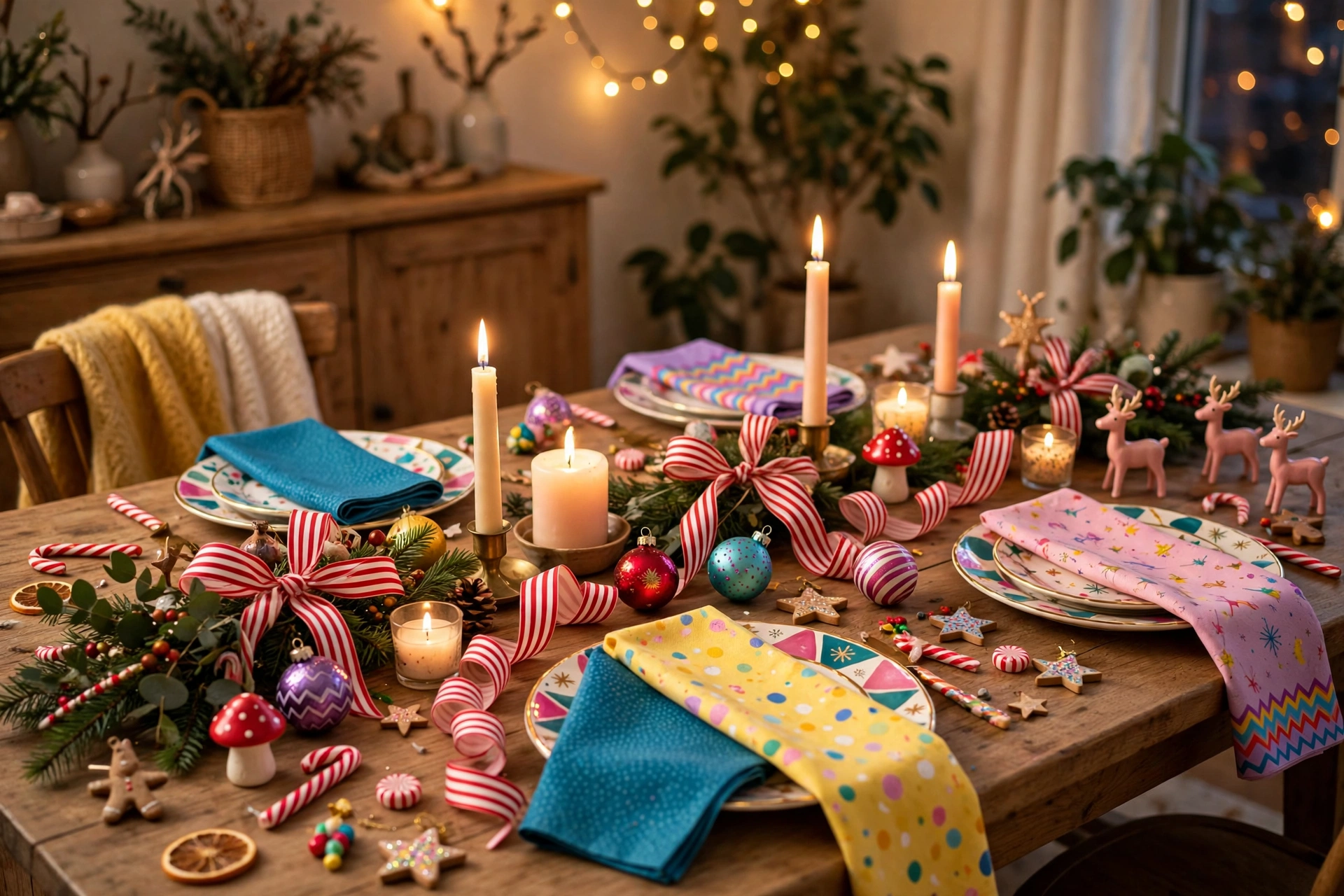
A Christmas table should feel festive when people sit down, and still leave room for plates, glasses, and serving dishes. Start with the table size. For a round table 1.2 metres across, about 4 feet, plan for a centrepiece no wider than 30 to 40 centimetres, so plates have room. For a rectangular table, plan for a runner or centrepiece that leaves at least 30 centimetres of clear space at each place setting.
A natural table setting is one of the strongest whimsy looks, and it is also practical. Use a plain tablecloth or runner in cream or deep green, then add a simple garland or a row of small greenery stems down the centre. Add warm white fairy lights inside the greenery, if the table will be used in the evening, and keep the lights battery operated, so no cable crosses the table. Add candles in glass holders, not open flames near greenery, and keep the total candle height below eye level when seated, so guests can see each other across the table.
Windows and Entry Ideas
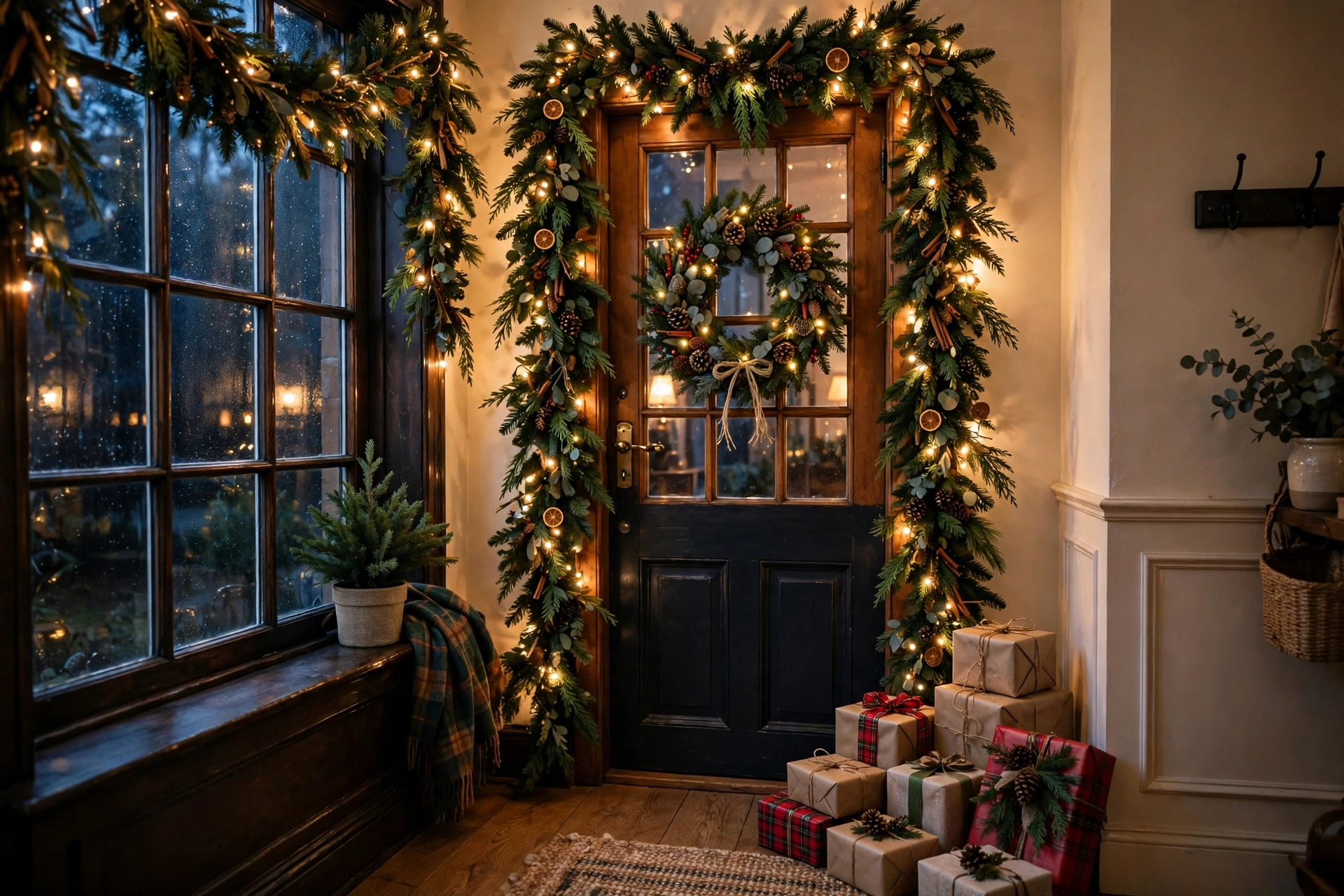
Windows and the entry are where a whimsy look first meets a visitor, and they work best with restraint. A window needs only one or two elements: a simple wreath, a string of warm white lights, or a row of paper stars. A wreath diameter of 45 to 60 centimetres, or 18 to 24 inches, suits a standard front door and a standard living room window. For a double window, use two smaller wreaths, one per pane, rather than one large wreath that covers the frame.
For the entry, focus on the door, the console or bench, and the floor. A wreath on the door, a small garland or a lantern on the console, and a doormat that can handle wet shoes are enough. In a small entry, a single statement piece, such as an oversized bow on the door or a tall lantern, reads as more festive than many small pieces crowded together.
Small Space Whimsy Christmas Ideas
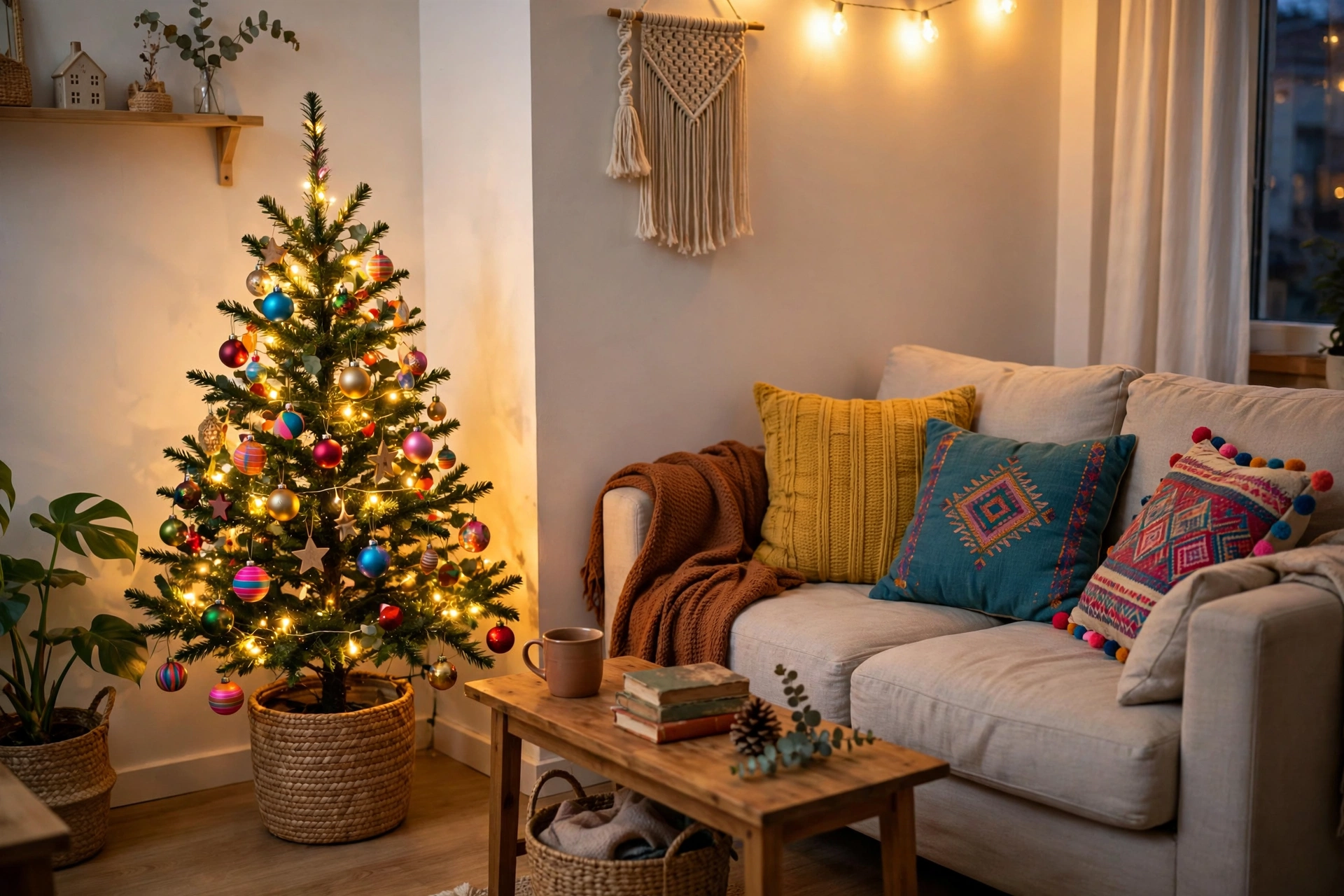
A small space does not need a smaller idea, only a smaller scale. The rules below help a whimsy look work in a studio, a small apartment, or a single room.
Use vertical space. A wall tree, a garland on a shelf, and ornaments hung from a curtain rod use height without using floor space. A tabletop tree, 60 to 90 centimetres tall, on a side table or a kitchen counter, can be the main tree in a small home, and it uses the same light and ornament ratios, scaled down.
Choose one focal point per room. In a studio, that might be the tree or the window, not both at full scale. Let the other area stay simple, with one candle cluster or one small garland, so the room does not feel crowded.
Keep walkways clear. Measure the main path through the room, and keep at least 75 to 90 centimetres, or about 30 to 36 inches, clear. A tree, a basket, or a lantern that blocks a walkway will feel like clutter, no matter how festive it looks in a photo.
What to Avoid in a Whimsy Room
Whimsy fails most often for a few repeatable reasons. Avoiding them matters more than adding more decor.
Avoid mixing palettes in one sightline. If the tree is pink and gold, the mantel should not be red and green. Choose one palette per room, as noted above.
Avoid too many patterns at the same scale. Stripes, dots, gingham, and florals can mix, but they should vary in size. One large stripe, one small dot, and one medium floral work better than three large patterns competing.
Avoid covering every surface. A room needs resting places: a plain sofa cushion, a clear coffee table edge, or an unadorned shelf. If every surface has decor, remove one layer from the least visible surface first.
Avoid fragile ornaments at child or pet height. Place heavier, unbreakable ornaments low, and glass ornaments higher, where they are less likely to be knocked. Secure a tree to a wall or a heavy stand if children or pets will be near it.
Avoid open flames near greenery, paper, and fabric. Use battery candles inside lanterns, in garland, and near paper chains. If real candles are used, keep them in glass holders, away from greenery, and never leave them burning in an empty room.
A Step by Step Decorating Order
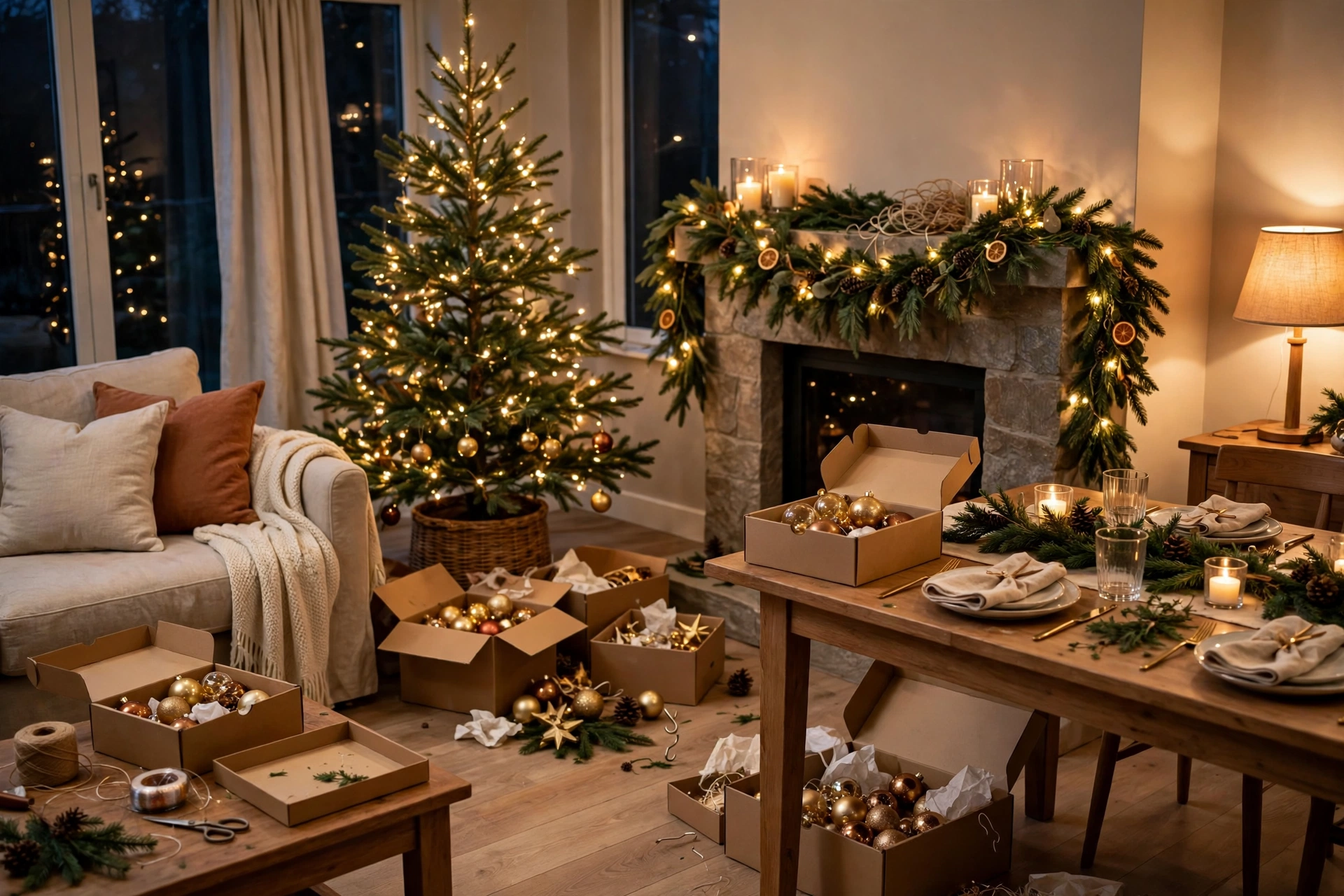
Decorating in order saves time and prevents rework. The order below is the one used in most guides for a tree based room, and it works for a whimsy room too.
1. Clean and clear. Remove everyday clutter from the tree area, the mantel, and the table. Put everyday cushions and throws that clash with the palette in a basket for January, and keep only the pieces that fit the chosen palette.
2. Measure and plan. Measure the tree space, the mantel, and the table, as noted above. Write down the palette, the light count, and the garland length, so shopping, if needed, is a single list.
3. Tree first. Place the tree and the skirt, add lights, then ribbon, then ornaments, then the topper. Step back after each step, and check from the doorway, not just from close up.
4. Mantel and shelves second. Hang garland, add lights, then accents, in the same palette as the tree. Mirror the main shapes, even if small details differ.
5. Table third. Lay the runner or cloth, add the centrepiece, then place settings. Check that plates, glasses, and serving dishes fit, and that candles are below eye level when seated.
6. Windows and entry fourth. Add a wreath, lights, or paper stars, in the same palette, with restraint. One or two elements per window is enough.
7. Final check. Walk the room at night, with only the Christmas lights on, and look for dark patches, unbalanced sides, and walkways that are blocked. Adjust lights and ornaments, not the palette, at this stage.
Budget Planning for a Whimsy Christmas

A whimsy look does not need a large budget, but it does need a budget, because small playful pieces add up quickly. Plan the budget in three parts: lights and basics, tree and garland, and accents.
Lights and basics, such as a tree skirt, ribbon, and hooks, are the foundation, and they can be reused for years. They are worth choosing in the palette colour, rather than the cheapest available option.
Tree and garland, if artificial, are multi year pieces. A plain evergreen garland that can be reused with different accents each year is usually better value than a pre decorated garland in one theme.
Accents, such as ornaments, felt garland, and paper chains, are low cost and high impact. They are the best place to add personality without spending much.
A simple budget rule is to spend most on lights and one statement piece, such as a large bow, a quality tree skirt, or a set of baubles in the palette, and the rest on small repeatable accents. Avoid buying a matching set for every surface. One set of baubles used on the tree, the mantel, and the table looks more intentional than three different sets.
Safety Notes for Candles, Lights, and Trees
Safety is part of the decor, not separate from it. Check light strings before use, and discard any with frayed wire, cracked bulbs, or a damaged plug. Do not connect more strings than the manufacturer allows, and do not run extension cables under rugs or across walkways. Turn lights off when leaving the house and before bed, or use a timer, so lights are not left on overnight.
For candles, use battery candles near greenery, paper, and fabric. Real candles should be in stable holders, away from curtains and garland, and never left burning unattended.
For a real tree, water it daily, keep it away from radiators and fireplaces, and remove it promptly when needles drop heavily, as a dry tree is a fire risk. For a home with children or pets, secure the tree, place breakable ornaments high, and keep small batteries out of reach.
Frequently Asked Questions
What is whimsy Christmas decor?
Whimsy Christmas decor is a playful, colourful approach to Christmas, with a clear palette, mixed patterns that share a colour, varied ornament sizes, and handmade or collected pieces. It usually has one focal point, often the tree, and it repeats that focal point’s colours in the mantel and the table.
How many lights do I need for a whimsy Christmas tree?
For a full glow, use 100 to 150 lights per foot. A 6 foot tree needs 600 to 900 lights, and a 4 foot tree needs 400 to 600 lights. Place lights inside the branches as well as at the tips, and keep all strings at the same colour temperature, preferably warm white.
How do I make a small living room feel whimsy without feeling cluttered?
Choose one focal point per room, use vertical space such as a wall tree or a shelf garland, and keep walkways at least 75 to 90 centimetres clear. Use a tabletop or slim tree, use fewer ornaments, about 30 to 40 for a 4 foot tree, and choose multi use pieces, such as a palette coloured throw that still works after December.
What colours work best for whimsy Christmas?
Three palettes work well: deep green, cream, and cherry red, with candy cane stripes; blush pink, cream, and soft gold; and deep green, warm brown, cream, and one bright accent, such as mustard yellow or berry red. Use a 60, 30, 10 ratio, about 60 percent main colour, 30 percent supporting colour, and 10 percent accent, and one palette per room.
How can I decorate for whimsy Christmas on a small budget?
Spend most on lights and one statement piece, such as a large bow or a quality tree skirt, and use low cost accents: paper chains, felt garland, dried orange slices, and pinecones. Use a single ribbon colour repeated on the tree, the mantel, and the wrapping paper, and buy a plain evergreen garland that can be reused, with different accents each year, rather than a new pre decorated set each December.
Conclusion
Whimsy Christmas works when play has a plan. Choose one palette, repeat it from tree to table, use lights first and in the right count, and let handmade and collected pieces add personality inside that palette. Keep walkways clear, keep candles safe, and leave resting places for the eye, so the room feels joyful, not busy. A small room, a rental, and a real budget can all carry a whimsy Christmas, as long as the focal point is clear and the details support it rather than competing with it. Start with the tree, follow the order above, and let the room grow a little each December, rather than trying to buy the whole look in one trip.