
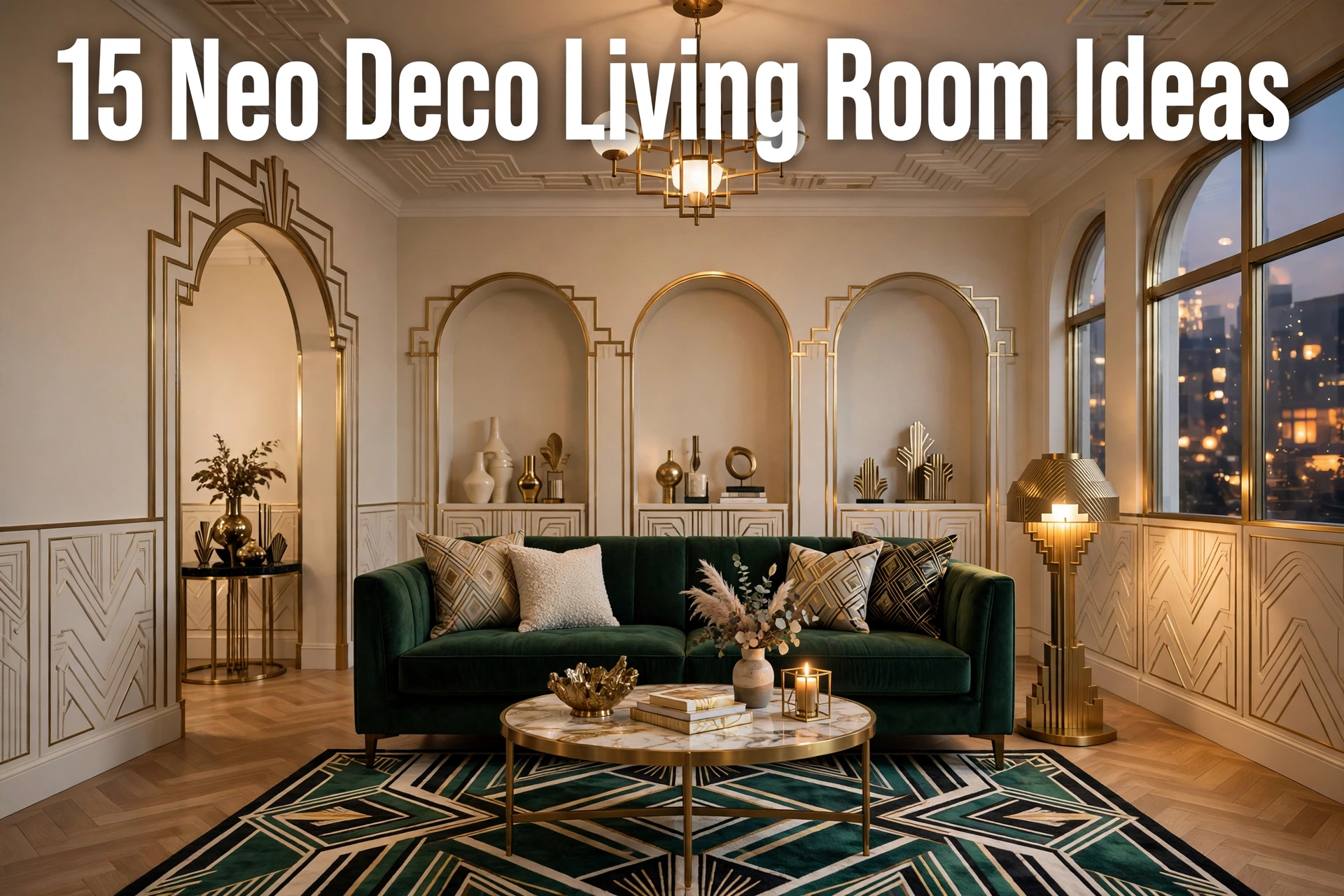
15 Neo Deco Living Room Ideas
Introduction: What Neo Deco Actually Means
Neo Deco is the modern return of Art Deco, updated for homes that need to be comfortable, not just dramatic. Original Art Deco, from the 1920s and 1930s, was built on geometry, symmetry, rich materials, and a love of glamour. It used fan shapes, sunbursts, chevrons, stepped outlines, and arches. It paired dark wood with brass, chrome, marble, velvet, and glass. Neo Deco keeps that structure but softens it. The colours are warmer, the furniture is lower and more comfortable, and the look works in a rented apartment as well as in a large house.
A literal copy of 1920s Deco can feel like a hotel lobby. Neo Deco works better because it uses one or two strong shapes, then lets the rest of the room stay calm. Think of it as a framework, not a costume. Choose a shape, a metal, and a colour family, and repeat those choices in small ways.
A useful starting rule is 70-20-10. About 70 percent should be a calm base, usually warm white, cream, pale grey, or a light warm neutral. About 20 percent should be a second colour, often deep green, navy, burgundy, or charcoal on a chair, curtains, or rug. About 10 percent should be the Deco accent, usually brass, chrome, black, or a bold pattern. When the accent stays at about 10 percent, the room looks intentional.
Geometry should also be clear. A fan mirror, a chevron cushion, an arched bookcase, or a stepped console can carry the theme. You do not need all four. Pick one shape, then use it twice or three times, not ten times.
Colour Palette: Rich, But Not Dark All Over

Neo Deco colour is rich, but it does not have to be dark. The classic palette pairs a deep jewel colour with a pale neutral and a warm metal. Good combinations include deep emerald green with cream and brass, navy with pale grey and chrome, burgundy with blush and aged brass, charcoal with warm white and black, and teal with sand and gold toned metal. For a lighter room, use the deep colour only on cushions, a throw, one chair, or one wall, and keep the sofa and the main rug in a neutral tone.
For paint, test a deep colour on one wall first, in daylight and evening light. Deep green and navy can look almost black in a room with little natural light. If your room is small or dark, use the deep colour on one accent wall behind the sofa, not on all four walls.
For renters who cannot paint, the same palette can be built with textiles and art. A deep green throw, two velvet cushions, a rug with a geometric border, and a brass floor lamp can create the palette without touching the walls. On a neutral sofa, use five cushions: two solid deep, two geometric in that colour plus a neutral, and one metallic or velvet. This gives pattern, colour, and shine, without every cushion competing.
Furniture Shapes: Curves, Steps, and Low Profiles
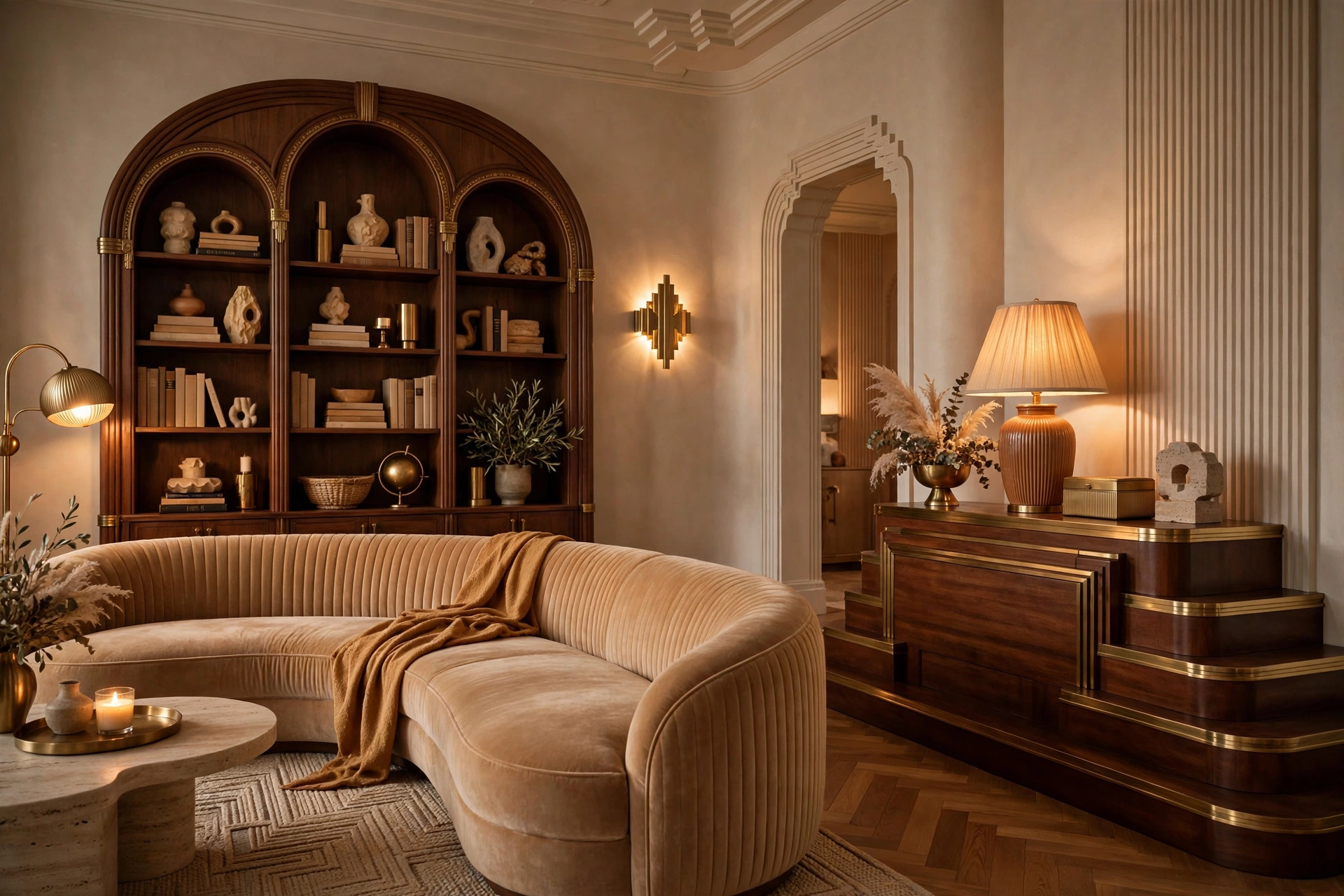
Neo Deco furniture is shaped, not boxy. Look for curved sofa arms, rounded chair backs, fluted details, stepped edges, and tapered legs. A sofa with a low, curved back and slim legs will read as Deco far more clearly than a tall, square sofa with chunky arms, even if both are in the same colour. If you are not replacing a sofa, you can add Deco shape with smaller pieces: a curved accent chair, a round side table, an arched floor lamp, or a console with a stepped front.
Scale matters more than style names. In a small living room, keep the main sofa to about 180 to 210 centimetres wide, with a seat depth of about 90 to 100 centimetres, so there is still clear walking space around it. Leave at least 75 centimetres for a main walkway, and at least 45 centimetres between the sofa and the coffee table, so people can move and sit comfortably. A round coffee table, about 80 to 90 centimetres across, works well in a small Deco room because it echoes the curved shapes and it has no sharp corners to bump into.
For larger rooms, a pair of matching accent chairs can anchor the Deco look. Place them facing the sofa, or angled toward a fireplace or a focal wall, with about 60 to 75 centimetres between them and the coffee table. A pair works better than a single chair for Deco symmetry, which is a core part of the style. Symmetry does not mean everything must match exactly. Two chairs in the same shape but in slightly different fabrics, or two lamps in the same metal but at slightly different heights, can still feel balanced if the overall outline is similar.
Fluted furniture is a simple Neo Deco signal. Use it in one or two places only, such as a fluted console plus a fluted lamp, or the room starts to look like a set.
Lighting: The Fastest Way to Get the Look

Lighting is often the fastest and most affordable way to bring Neo Deco into a living room, and it is also where many rooms go wrong. Deco lighting should be layered: one main ceiling light or pendant, one or two table or floor lamps, and one small accent light such as a picture light or a candle style lamp. Warm white light, around 2700K, suits velvet, brass, and deep colours far better than cool white light, which can make brass look harsh and green look grey.
A pendant with a fan shape, a globe, or a stepped shade can be a focal point. Hang it about 75 to 85 centimetres above a coffee table, or about 210 centimetres from the floor in a walkway, so it does not block sight lines. Table lamps should be about 60 to 75 centimetres tall in total on a side table, with the shade bottom at about seated eye level, roughly 110 to 120 centimetres from the floor. A pair of matching table lamps on either side of a console or sofa is a classic Deco move.
Brass and chrome lighting can be mixed, but keep one metal dominant. If your main pendant is brass, use brass for the largest lamp, and use chrome only in small details such as a picture frame or a tray. If your room already has chrome fixtures that cannot be changed, such as chrome curtain rods or chrome door handles, make chrome the dominant metal and add brass only in warm, small touches such as a candle holder or a vase. Mixing equal amounts of brass and chrome in the same sight line is what usually looks clashed, not the metals themselves.
Mirrors and Art: Geometry on the Wall
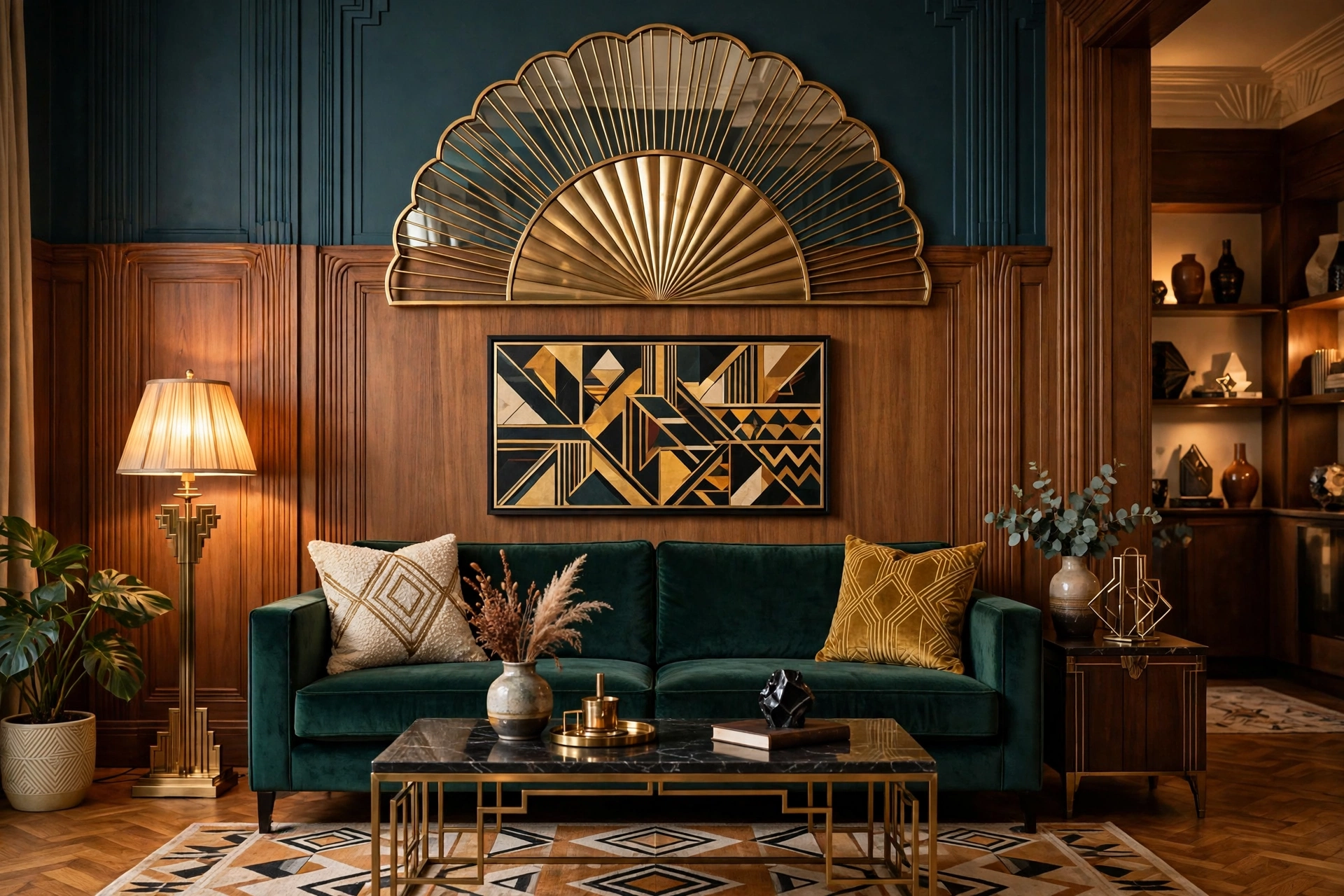
Mirrors are a signature Neo Deco element, and they also help small rooms feel larger. An arched mirror, a fan shaped mirror, or a round mirror with a brass frame can act as the main wall feature above a sofa or a console. For a sofa that is about 200 centimetres wide, a mirror about 120 to 150 centimetres wide, hung with its centre at about 145 to 155 centimetres from the floor, usually looks balanced. A mirror that is wider than the sofa, or hung too high, will look out of proportion.
If you use a gallery wall instead of one large mirror, keep the geometry clear. Use frames in the same metal, or in black with a brass inner edge, and keep the spacing even, about 5 to 8 centimetres between frames. Include one fan or arch shape in the group, such as a small arched print, so the wall reads as Deco rather than as a random collection. Abstract art with bold arcs, sunbursts, or chevrons works well, but keep the colours tied to the room palette. One large print, about 80 by 100 centimetres, often works better than many small prints in a Deco room, because it gives the eye a clear focal point.
For renters, lean a large mirror on a console rather than hanging it, secure it at the top where possible, and do not block a walkway.
Textiles: Velvet, Pattern, and How Much Is Enough
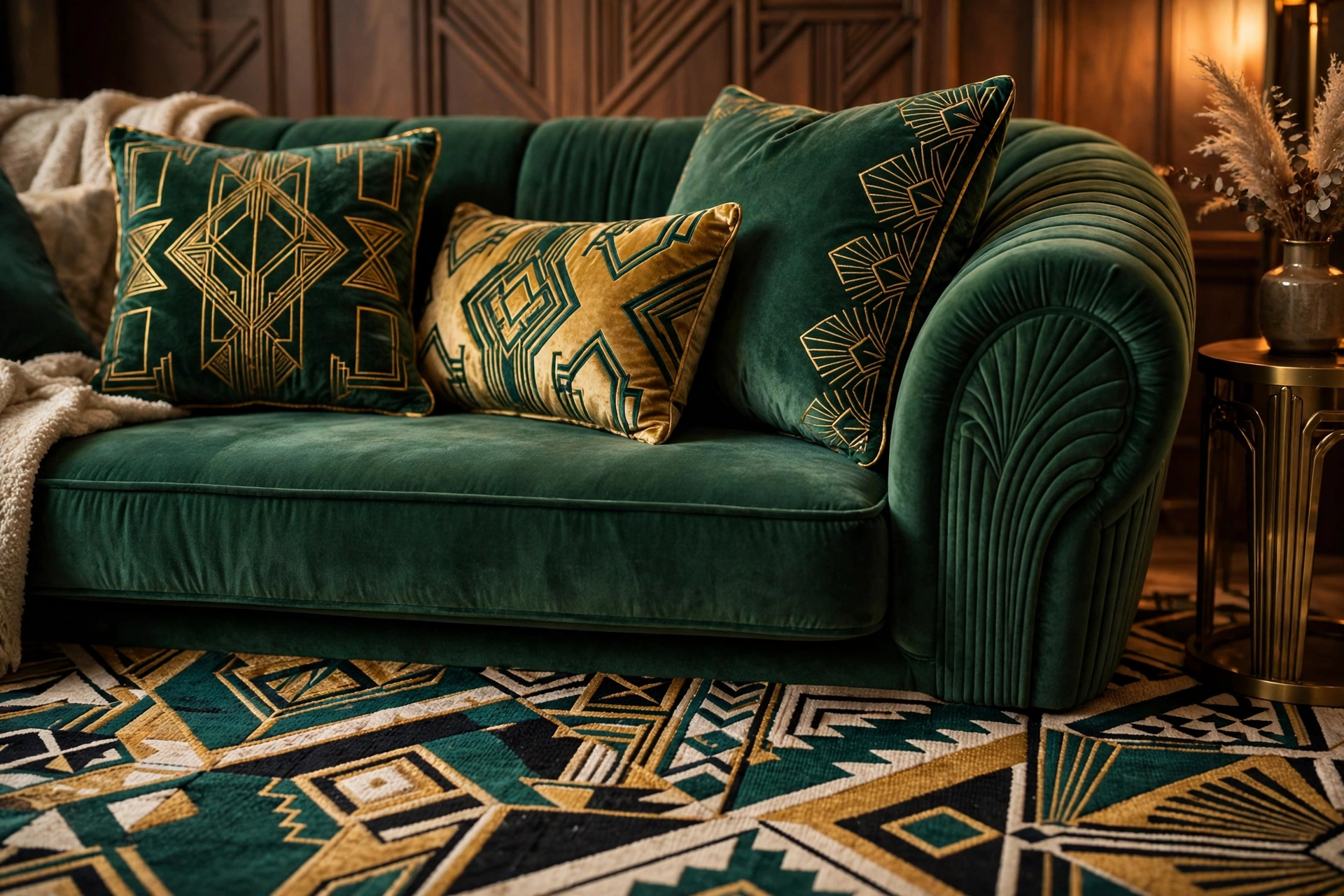
Textiles carry much of the Deco feeling, and they are also the easiest place to overdo it. Velvet is the classic Deco fabric, and it works best in deep colours on cushions, a throw, or one accent chair. A full velvet sofa can be beautiful, but it is harder to clean and it can make a small room feel heavy. For most living rooms, velvet cushions and a velvet throw give the same luxury signal with far less commitment and cost.
Pattern scale is the detail that separates a calm Deco room from a busy one. Use one large scale pattern, such as a fan or a large chevron on a rug or on curtains, one medium scale pattern on cushions, and one small scale pattern on a throw or a small pillow. If all three patterns are large, they compete. If all three are small, the room can look flat. A rug with a geometric border, rather than a full geometric field, is a good compromise for a small room, because it frames the seating area without dominating it.
Curtains can add Deco height. Hang rods about 15 to 20 centimetres above the window frame and beyond each side, so the window looks taller and wider. Floor length curtains in a solid deep colour suit Neo Deco well. Avoid short sill length curtains, because they cut the vertical line Deco relies on. For throws, choose one solid textured throw, draped over one sofa arm, in warm cream or soft gold to lighten a deep room.
Small Room Neo Deco: How to Keep It Light
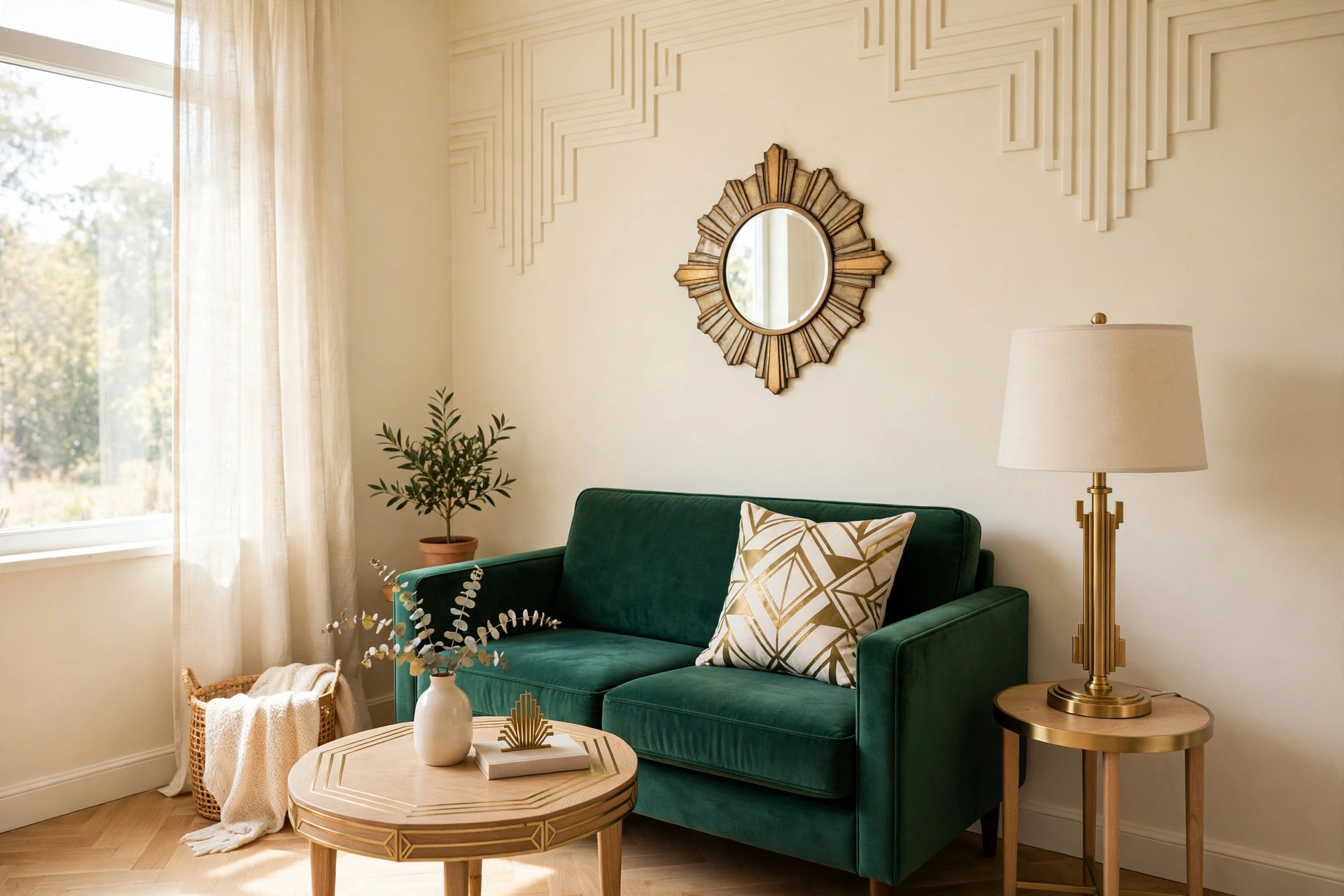
Small rooms can do Neo Deco well, but they need restraint. The most common mistake in a small room is using too many Deco elements at once: a patterned rug, patterned cushions, a patterned curtain, a fan mirror, a brass pendant, and a fluted console, all in the same sight line. Choose three Deco signals for a small room, and let the rest of the room stay simple. A good trio is one arched mirror, one brass lamp, and one geometric rug, or one velvet chair, one fan cushion, and one brass tray.
Use light deliberately. A mirror opposite a window can double natural light, but it should reflect a pleasant view, not a cluttered corner. Keep the rug light if the walls are deep, or the walls light if the rug is deep. Furniture on slim legs helps a small room feel open, because you can see floor underneath it. Avoid a large dark floor length storage unit if possible. For open plan rooms, use a rug at least 160 by 230 centimetres for a standard three seat setup, so the front legs of the sofa and chairs sit on it. A rug that is too small makes the seating area look scattered.
What to Avoid: Five Common Neo Deco Mistakes
First, avoid mixing too many metals at equal strength. Brass, chrome, gold, black, and copper can all appear in a home, but in one room, one metal should lead. Use the second metal only in small, repeated details, such as frames or a tray, and keep it to about 20 percent of the metal in the room.
Second, avoid using every Deco shape at once. Fan, sunburst, chevron, arch, stepped outline, and scallop are all Deco shapes, but a room that uses all of them looks like a theme park. Pick one main shape and one supporting shape, and repeat them.
Third, avoid matching everything exactly. A Deco room should feel curated, not bought as a set. A sofa, two chairs, a rug, curtains, and lamps all in the same pattern and the same colour will look flat. Let one or two pieces be patterned, and let the rest be solid, so the pattern has room to breathe.
Fourth, avoid dark walls plus dark furniture plus a dark rug in a small or north facing room. One dark element is dramatic. Three dark elements together can make the room feel smaller and harder to light, even with lamps.
Fifth, avoid ignoring scale. A tiny fan mirror above a large sofa, or a huge pendant in a low ceiling room, will look wrong even if the style is right. Measure the wall, the sofa, and the ceiling height before buying a focal piece, and use the size guides in this article as a starting point, not as a rule that must be followed exactly.
Step by Step Room Plan: From Plain Room to Neo Deco

Step one, clear and measure. Remove one or two items that do not serve the room, measure the sofa wall, the window width, the ceiling height, and the walking routes, and note the existing metal finishes that cannot be changed, such as curtain rods, door handles, or light switches. This list becomes your metal and colour constraint, and it prevents buying a brass pendant that clashes with fixed chrome.
Step two, choose the palette. Pick a base neutral, a deep accent colour, and a dominant metal, using the 70-20-10 guide above. Write the three choices down, and check every new purchase against them. If a cushion, a lamp, or a rug does not include at least one of those three, it probably does not belong in this room yet.
Step three, choose the focal wall. This is usually the wall behind the sofa, or the wall with the fireplace or the television. Place the largest Deco element here: an arched mirror, a large fan print, or a pair of matching lamps on a console. Keep the focal wall to one main idea, not three competing ideas.
Step four, add lighting. Start with the main pendant or ceiling light, then add one floor lamp or two table lamps in the dominant metal. Use warm white bulbs throughout, and use dimmers where possible, so the room can shift from bright daytime use to cosy evening use without changing the decor.
Step five, add textiles in order: rug first, then curtains, then cushions, then throw. This order matters because the rug sets the pattern scale, and the cushions should respond to the rug, not compete with it. If the rug is patterned, keep the cushions mostly solid. If the rug is solid, the cushions can carry the pattern.
Step six, add small Deco details last: a brass tray, a geometric vase, or a candle holder. Keep them easy to move, test the room for a week, then remove anything that feels busy.
Budget Tiers: Under 100 Dollars, Mid Range, and Larger Investment
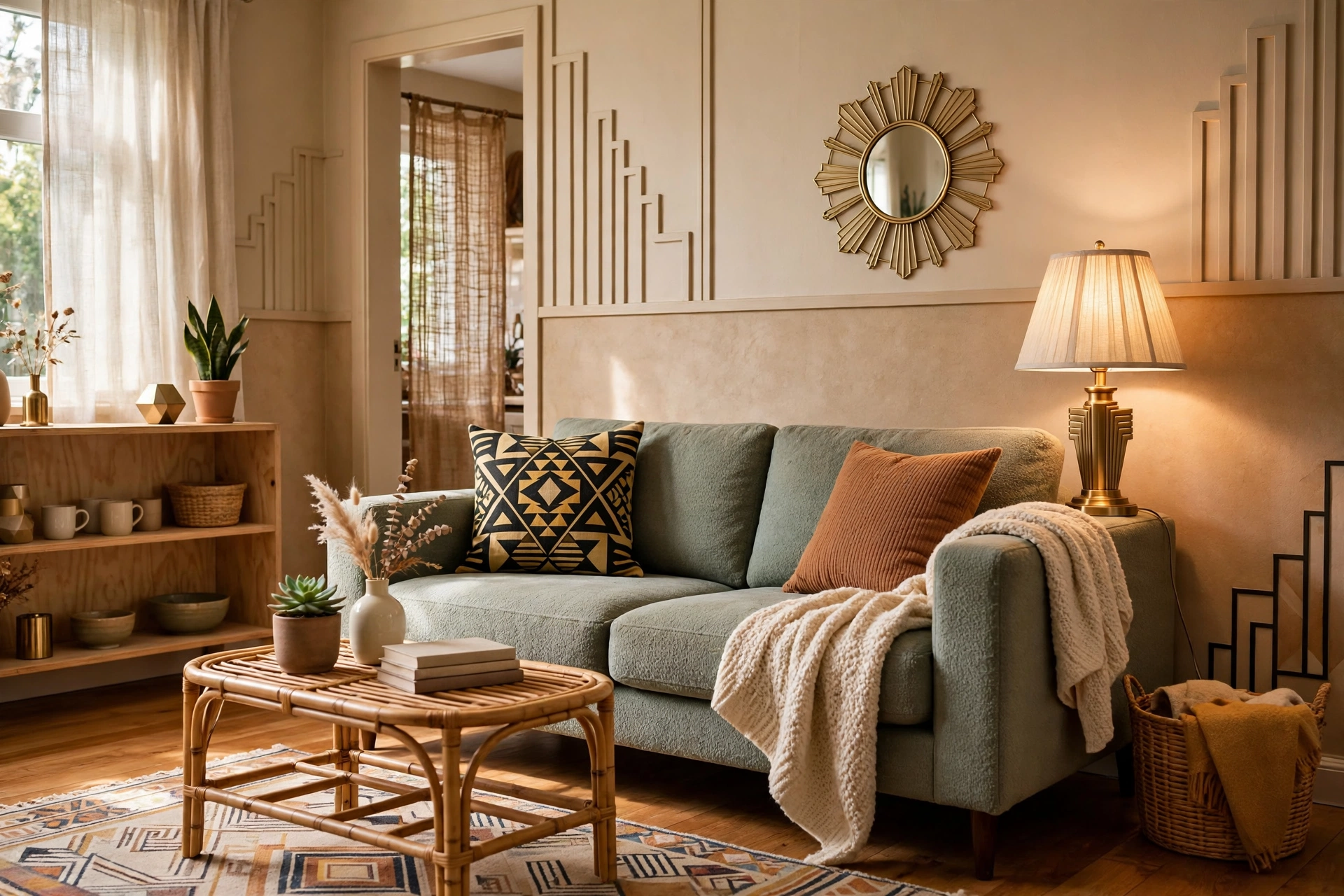
Under 100 dollars, focus on swaps, not furniture. Change the light bulbs to warm white, add a brass tray, two velvet cushion covers, a fan shaped picture in a brass frame, and a solid deep throw. Paint one piece of furniture you already own, such as a side table, in a deep colour with a brass knob, and replace one lamp shade with a stepped or pleated shade. These changes alone can shift the room from plain to Neo Deco, because they add colour, metal, and geometry at the points the eye naturally lands on.
Mid range, focus on one large anchor plus lighting. Replace a pendant or a pair of table lamps in brass or chrome, add a larger arched or fan mirror, and replace the rug with a geometric bordered rug in the room palette. If the sofa is still comfortable, re-cover it with a solid deep cover, or add a set of matching velvet cushions and a throw. A mid range plan is often the best value, because it changes the room’s focal points without replacing everything.
Larger investment, focus on furniture shape and finish. Replace the sofa with a curved or low profile model, add a pair of matching accent chairs, and add a console with fluted or stepped detail. At this level, keep the colour and metal choices consistent, and avoid buying a new piece just because it is labelled Deco. Check the shape, the leg height, the seat depth, and the fabric against the guides above, and test the piece in the room before committing to a full set.
Frequently Asked Questions
What is Neo Deco?
Neo Deco is the modern version of Art Deco. It keeps the geometry, symmetry, and rich materials, but it uses warmer colours, lower furniture, and fewer bold elements, so it works in everyday homes.
How many Deco elements should I use in one room?
Use one main shape, one dominant metal, and one deep colour, repeated in small ways. Three strong Deco signals in a small room, or five to six in a large room, are usually enough.
Can I do Neo Deco in a rented home?
Yes. Use textiles, mirrors, lamps, and art, rather than paint or built in changes. A deep throw, velvet cushions, a geometric rug, and a brass lamp can create the look without altering the walls.
What colour goes best with brass?
Brass works best with warm neutrals and deep colours such as emerald, navy, burgundy, or charcoal, plus cream or warm white. Cool white walls can make brass look harsh, so add warmth with wood or warm textiles.
How do I stop Neo Deco from looking too dark?
Keep the base light, use the deep colour on one wall or on textiles only, and add mirrors, warm lighting, and light coloured rugs or throws. One dark element is dramatic, three dark elements together can feel heavy.
Conclusion: Start With One Shape, One Metal, One Colour
Neo Deco works best when it is planned, not collected at random. Start with one shape, such as a fan or an arch, one metal, such as brass or chrome, and one deep colour, such as emerald, navy, or burgundy. Repeat those three choices in lighting, textiles, and one focal wall, and keep the rest of the room calm.
A living room does not need to be rebuilt to feel Deco. A new pendant, a mirror, a rug, and a set of cushions can change the whole feeling of a room, and a clear plan will stop the room from becoming busy. Choose your three Deco signals, test them in the room, and let the rest of the space stay simple, so the geometry, the metal, and the colour have room to shine.