20 Christmas Tree Ideas for Every Room, Style, and Budget
The Christmas tree is the centre of the season in most homes, and it is also the decoration people feel most pressure about. It should look full, it should suit the room, it should be safe for children and pets, and it should not take a whole weekend to decorate. The good news is that a good tree is a method, not a talent. Size first, lights second, ribbon and garland third, ornaments fourth, topper last, and a step back after each stage to check the balance.
This guide gives you 20 Christmas tree ideas for every room, style, and budget, with the measurements for tree size, light counts, and ornament numbers that make each idea work. It covers real and artificial trees, small spaces, colour palettes, and the decorating order that saves time. The full list, measurements, and step by step method are in this post, because a photo of a finished tree cannot show you how many lights you need or how to hang ornaments so the tree looks full from the doorway.
Choose the size before you choose the style
Measure the ceiling height, then subtract at least 30 centimetres, about 12 inches, for the topper and for clearance. A 1.8 metre tree, about 6 feet, suits a standard living room with a ceiling around 2.4 metres, about 8 feet. A 2.1 metre tree, about 7 feet, suits a room with a ceiling of 2.7 metres or more.
Measure the floor space too. A full 1.8 metre tree needs a diameter of about 1.1 to 1.3 metres at the base. A slim tree needs about 0.8 to 0.9 metres, and a tabletop tree needs a table or a stand at least 60 centimetres across. If the tree blocks a walkway, or if you have to squeeze past it to reach a door, it is too large for the room, no matter how beautiful it looks in a shop.
For lights, use 100 to 150 lights per foot of tree height for a full glow. A 6 foot tree needs 600 to 900 lights, a 4 foot tree needs 400 to 600 lights, and a 7 foot tree needs 700 to 1,050 lights. For ornaments, plan for 70 to 100 ornaments on a 6 foot tree, 30 to 40 on a 4 foot tree, and 100 to 130 on a 7 foot tree, with a mix of small, medium, and large sizes.
Real or artificial: how to choose
A real tree smells wonderful and looks natural, but it needs water daily, it drops needles, and it must be kept away from heat sources. Check the water level every day, and remove the tree promptly when needles start to drop heavily, because a dry tree is a fire risk.
An artificial tree costs more at first, but it can be reused for years, it does not drop needles, and it comes in slim, full, flocked, and pre lit versions. If you buy pre lit, check that the lights are warm white or the colour temperature you want, and that spare bulbs are available. If you buy unlit, you can choose your own lights each year.
Choose a real tree if you love the scent and the tradition, and you are happy to water it and clean up needles. Choose artificial if you want the same tree every year, you have allergies, or you want a slim or flocked tree that is hard to find as a real tree.
1. The classic red and green tree
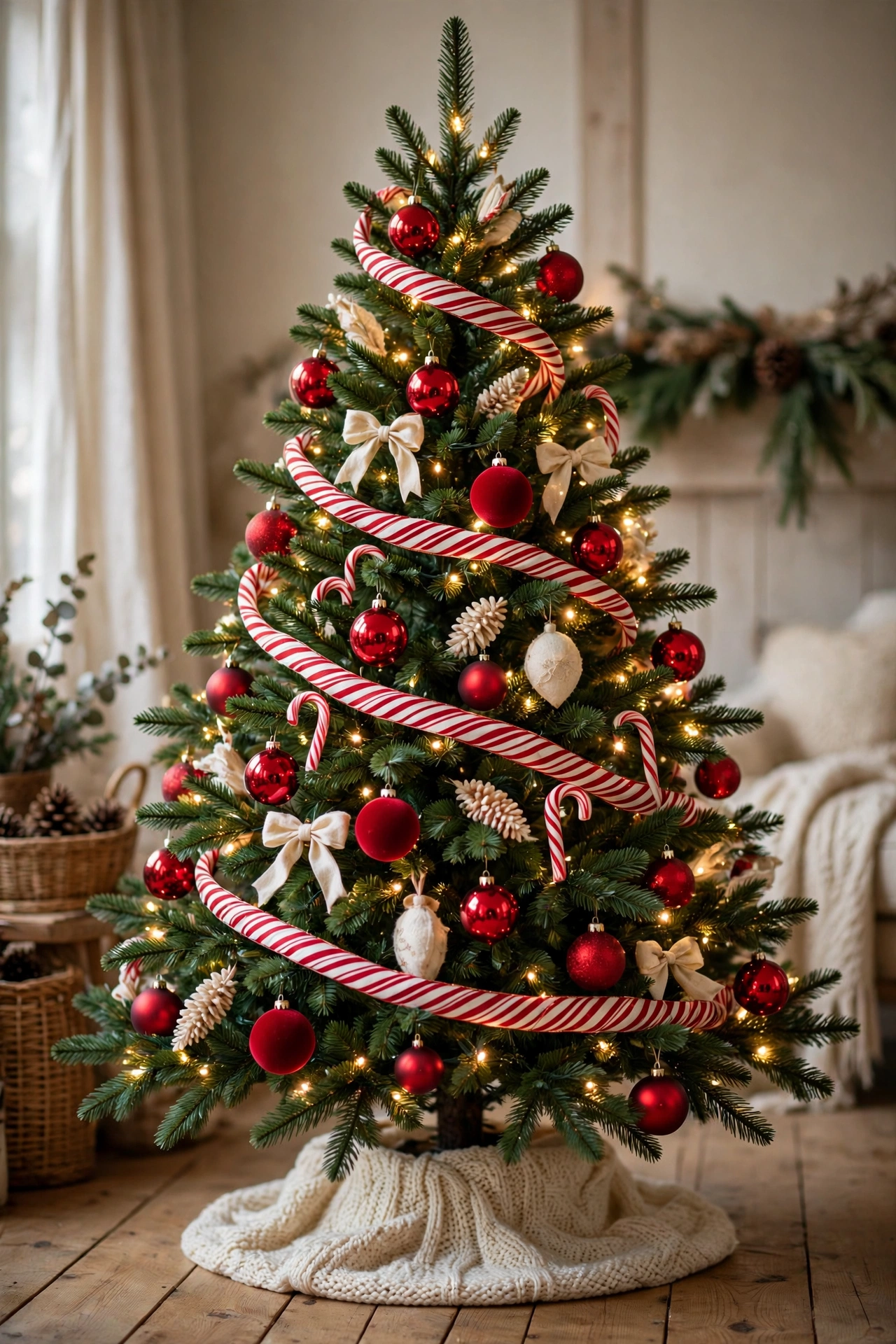
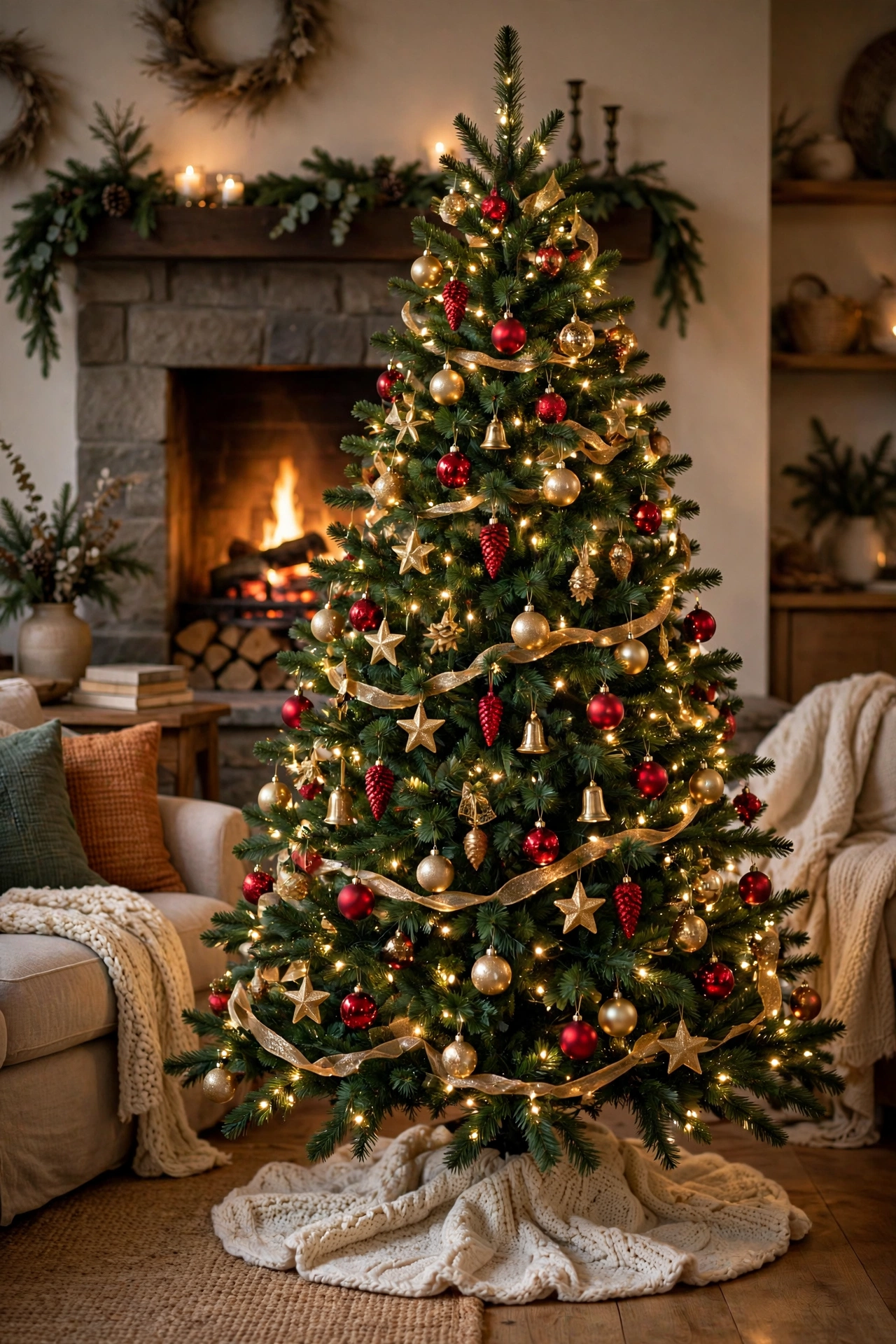
Deep green, cream, and cherry red, with candy cane stripes, is the easiest Christmas tree to decorate, because most ornaments, ribbons, and wrapping paper already come in these colours. Use warm white lights, red ribbon in 3.8 to 6.3 centimetre widths, and a mix of shiny and matte baubles.
Hang large ornaments lower and toward the outside, where they can be seen, and small ornaments higher and deeper in the branches. Add a star or a bow topper in red or gold, and a tree skirt in cream or deep green to hide the stand.
2. The pink and gold tree
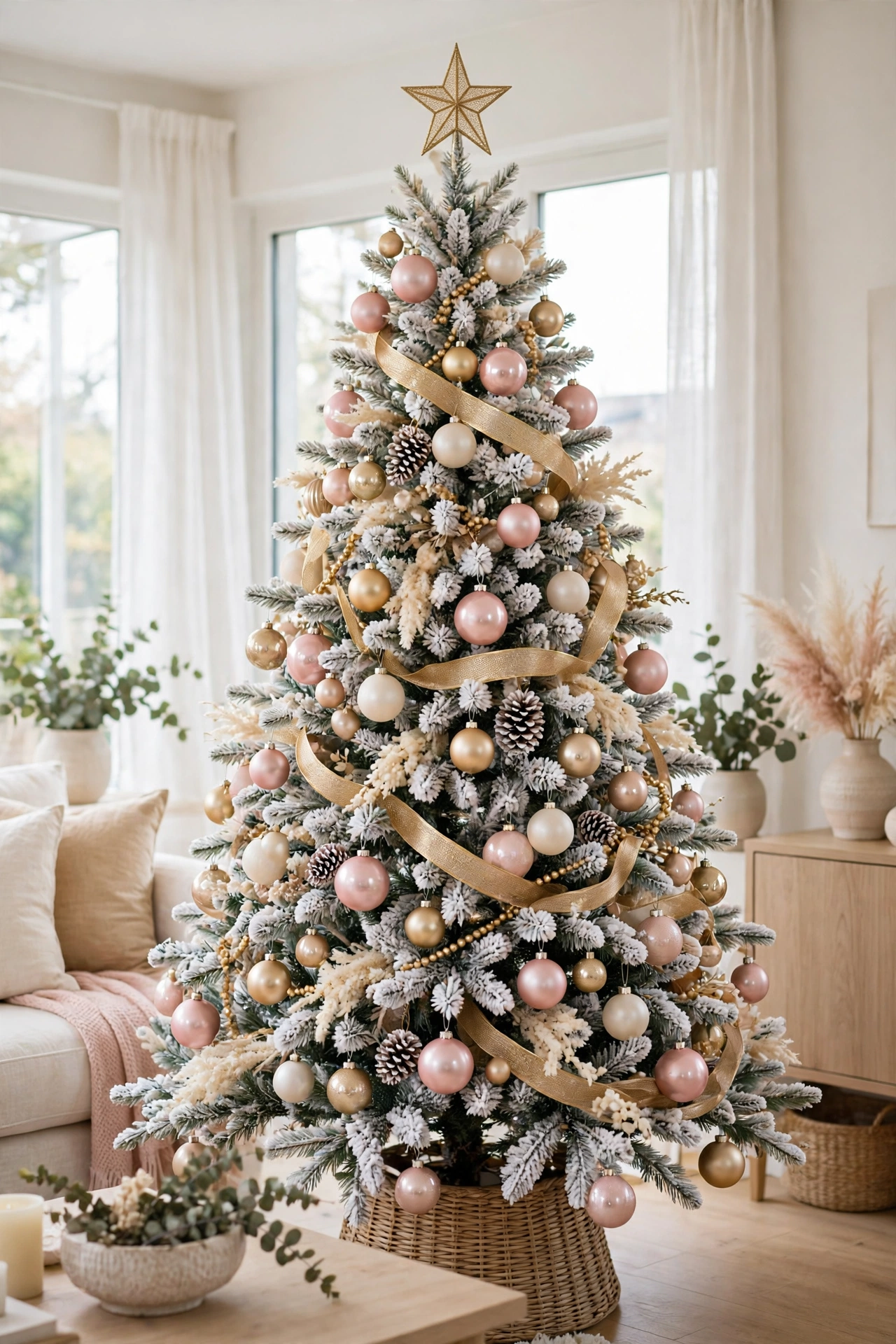
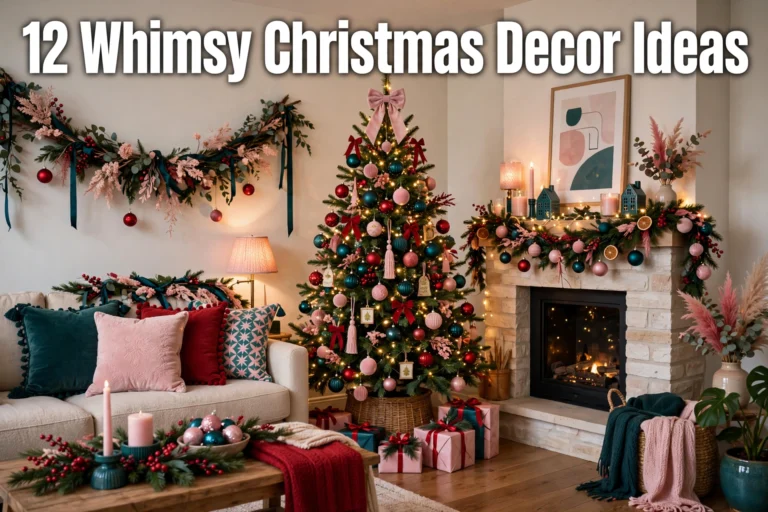
Blush pink, cream, and soft gold suits a light room, a white or cream sofa, and a smaller tree, because pink reads as playful without feeling loud. Use warm white lights, pink and gold baubles, a gold ribbon, and a few white or cream ornaments to keep the tree from looking too pink.
This tree works well with a white or flocked artificial tree, because the pale branches make the pink and gold stand out. Add a gold star topper, and a white or blush tree skirt.
3. The white and silver winter tree
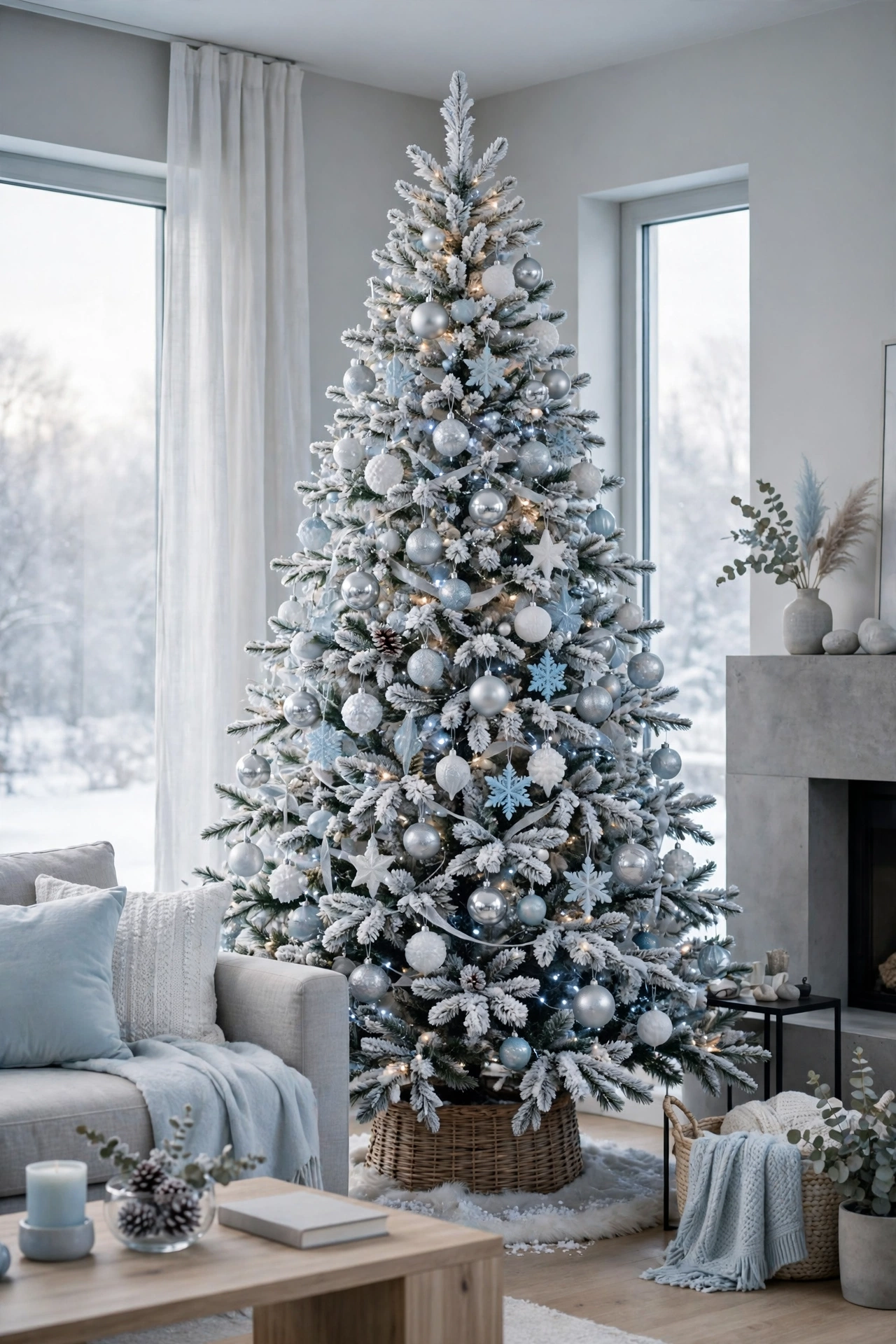
White, silver, and pale blue gives a tree a snowy, winter feel, even in a warm climate. Use cool white or warm white lights, silver baubles, white ornaments, and a little pale blue for depth.
This style suits a modern living room with grey or white furniture. Use a flocked tree if you can, because the white tips make the silver ornaments glow, and add a silver or white star topper. Keep the ribbon to one colour, silver or white, so the tree stays calm.
4. The woodland tree
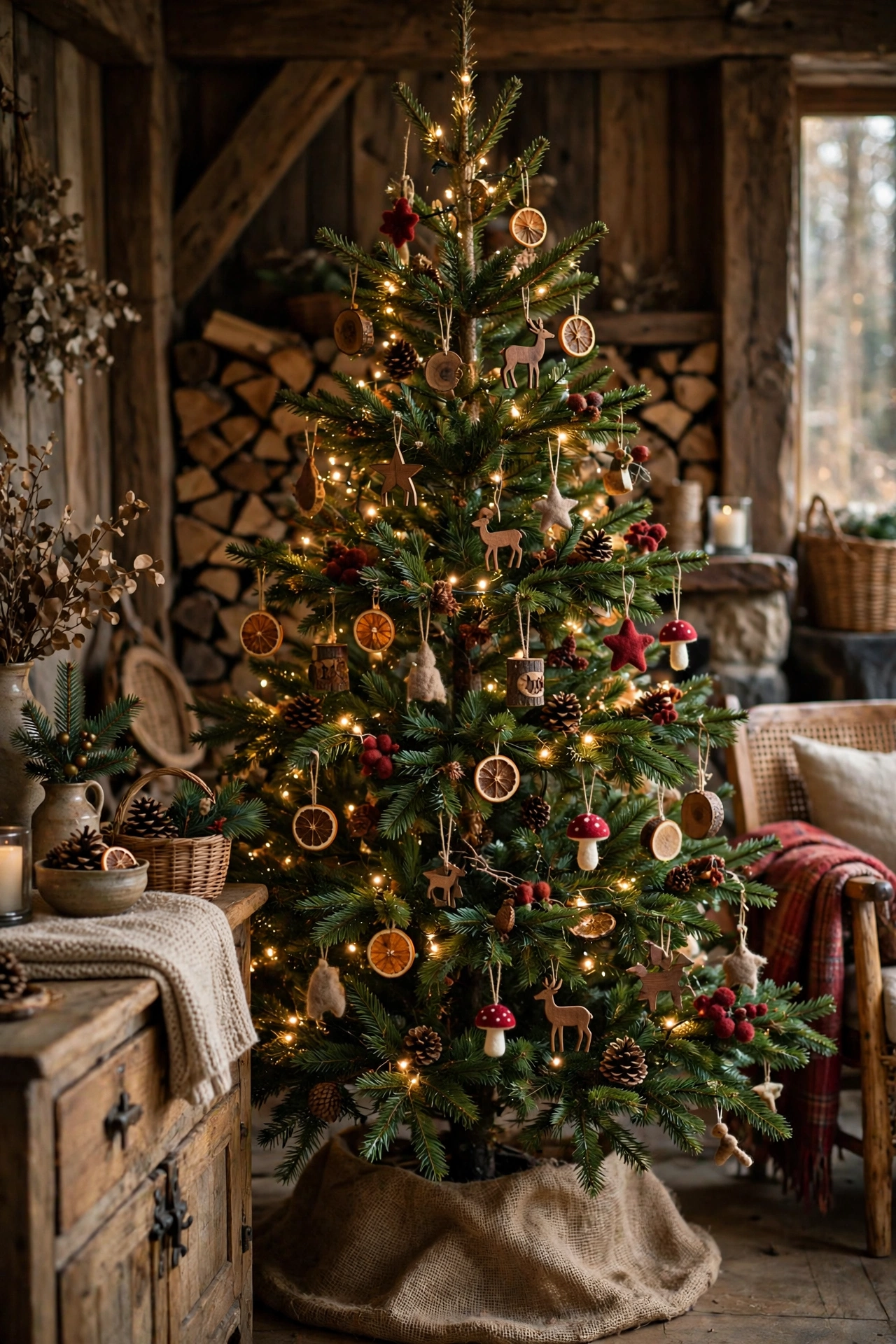
Deep green, warm brown, cream, and one bright accent, such as berry red or mustard yellow, gives a tree a woodland feel. Use wooden ornaments, pinecones, dried orange slices, and felt ornaments, with warm white lights.
This tree suits a room with wood furniture, baskets, and natural textures. Add a wooden star or a simple bow topper, and a hessian or burlap tree skirt. Avoid plastic ornaments in bright colours on this tree, because they will clash with the natural materials.
5. The flocked tree
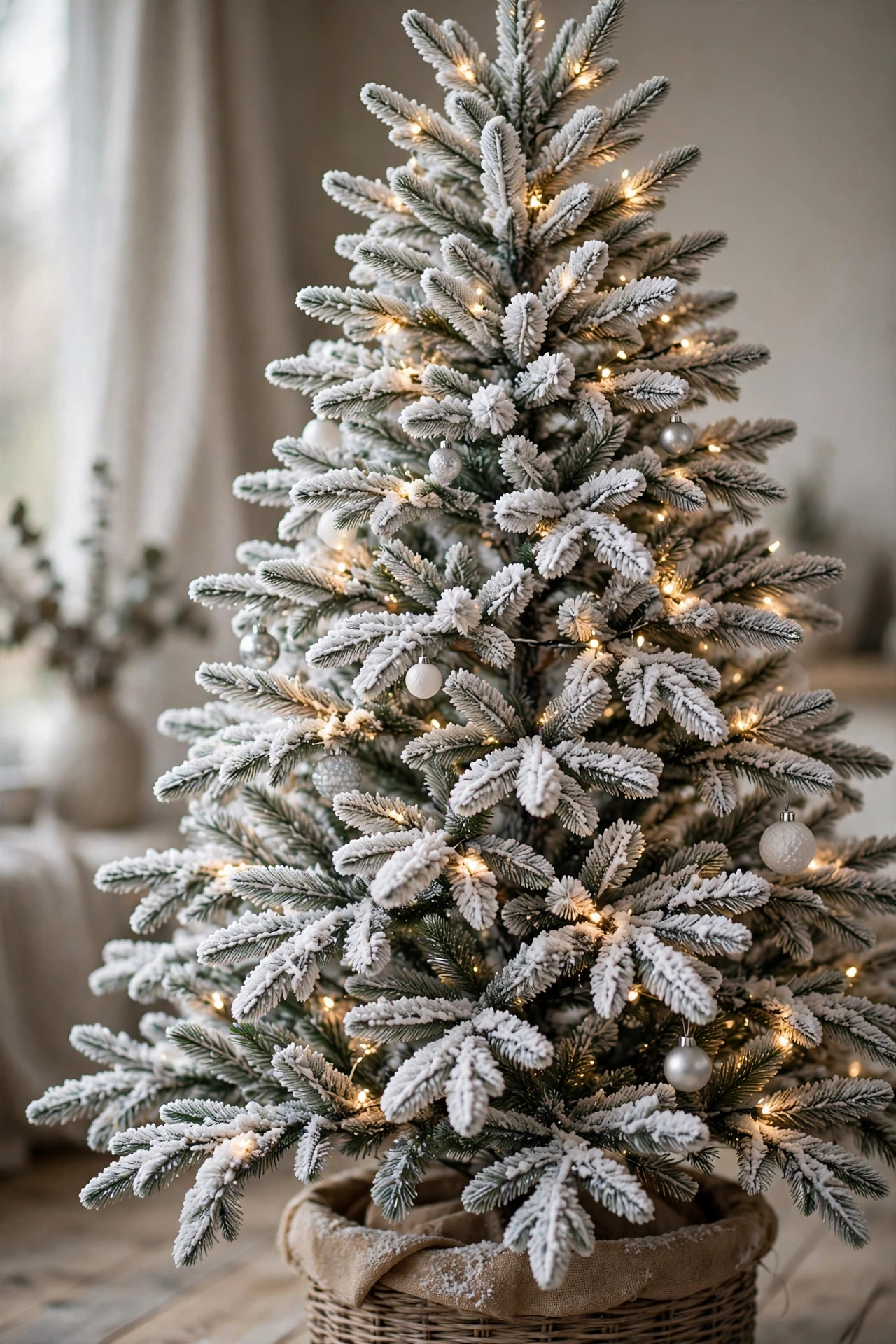
A flocked tree is an artificial tree with white tips that look like snow. It suits a white and silver palette, a pink and gold palette, or a woodland palette, because the white branches make every colour stand out.
Flocked trees shed a little flock when you first set them up, so assemble the tree outside or on a sheet, and shake it gently before you bring it into the living room. Use warm white lights, and avoid overloading a flocked tree with ornaments, because the flock is part of the look, and too many ornaments will hide it.
6. The slim tree for a small room
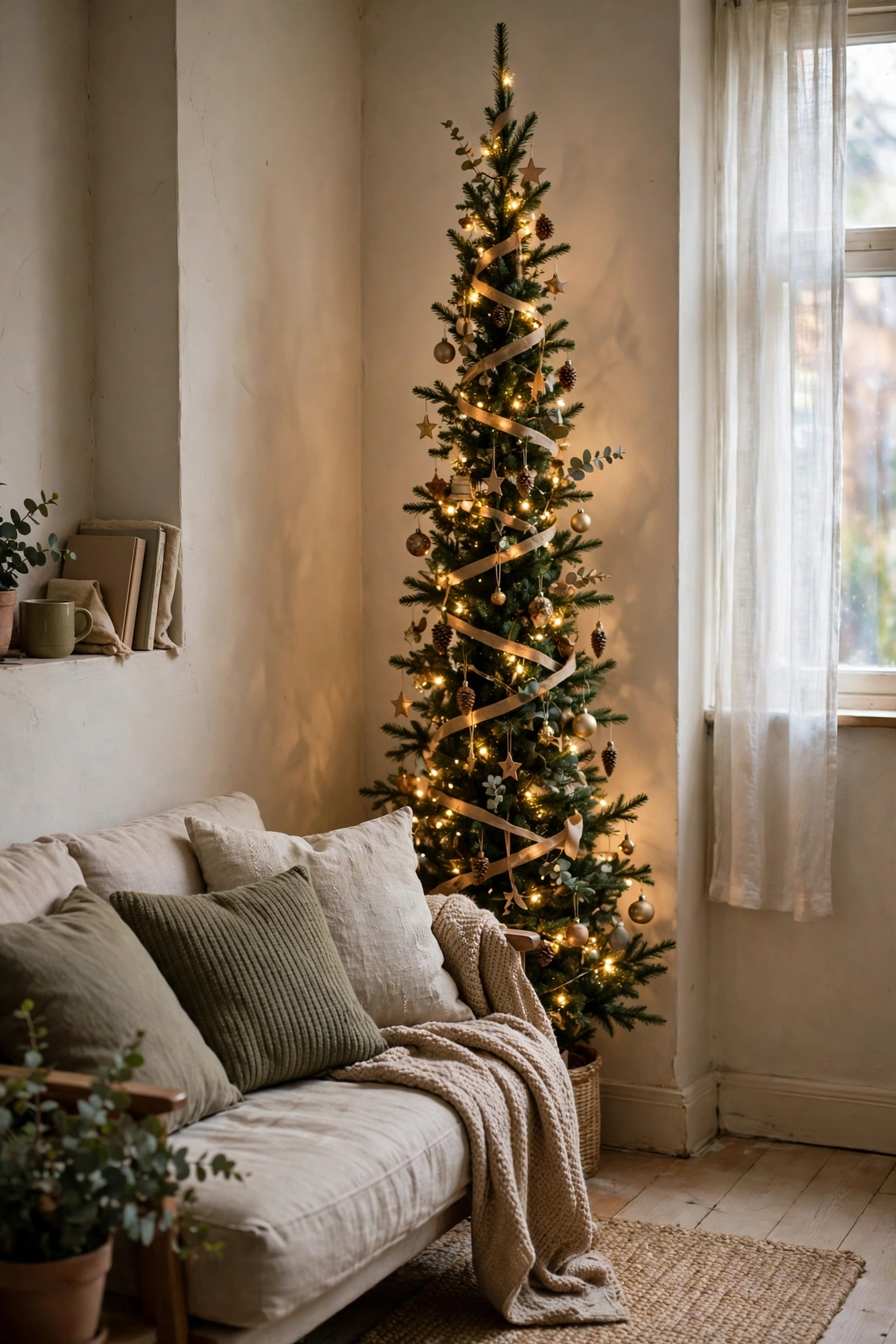
A slim tree is the answer for a small living room, a flat, or a hallway. A 1.8 metre slim tree needs only 0.8 to 0.9 metres of floor diameter, and it still gives you the full height and the festive shape.
Decorate a slim tree with smaller ornaments, and use a narrower ribbon, about 2.5 centimetres, so the tree does not look overloaded. Use 50 to 70 ornaments on a 6 foot slim tree, and keep the lights to the lower end of the range, about 100 lights per foot, so the tree does not look too dense.
7. The tabletop tree
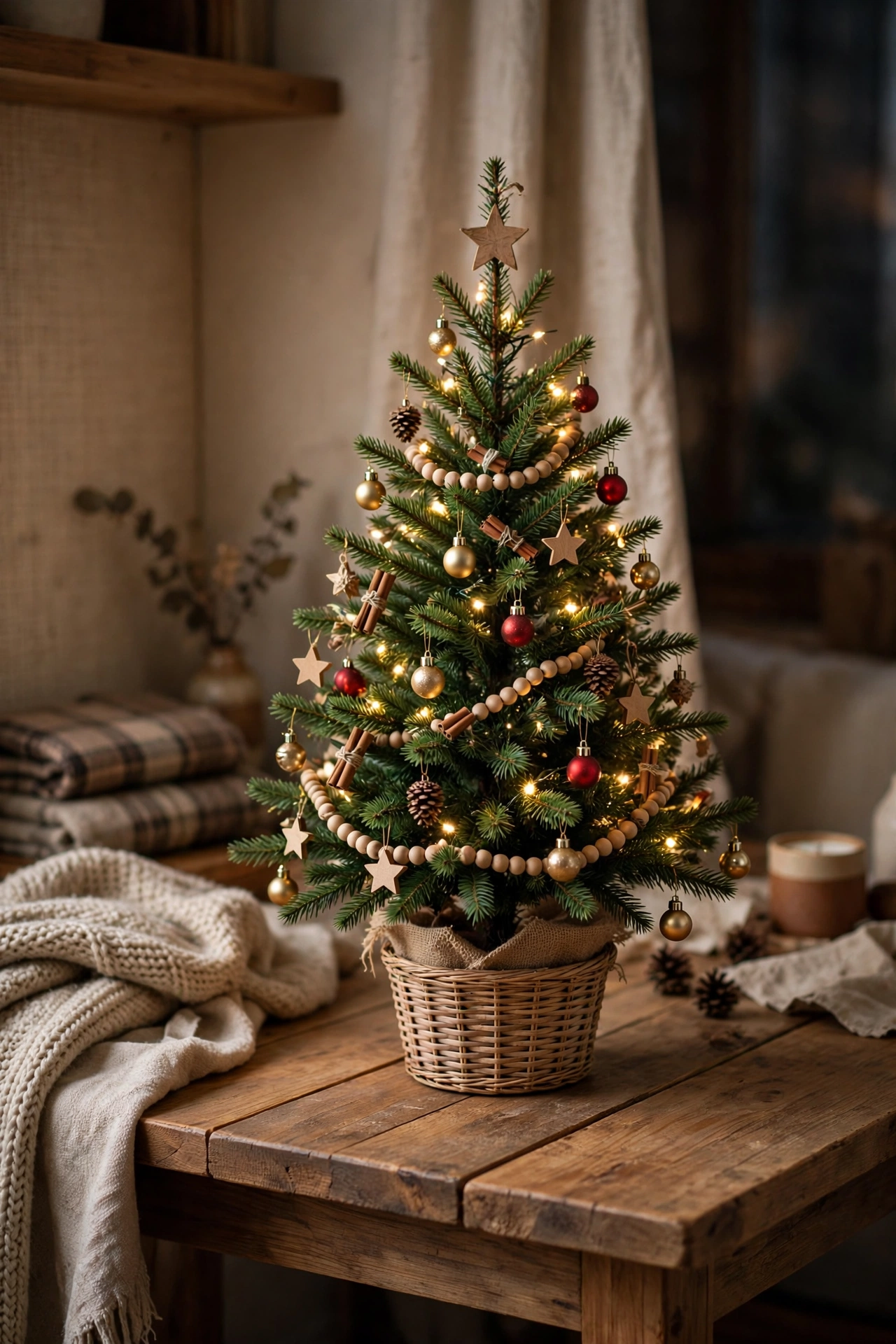
A tabletop tree, 60 to 90 centimetres tall, is the main tree in a small home, and a second tree in a larger home, for a bedroom, a kitchen, or a child’s room. Use 20 to 30 ornaments, 200 to 300 lights, and a small topper.
Place the tabletop tree on a stable table or a stand at least 60 centimetres across, away from the edge, so it cannot be knocked off. A tabletop tree in a child’s room should use unbreakable ornaments, placed low enough for the child to reach them safely.
8. The tree for a child’s room
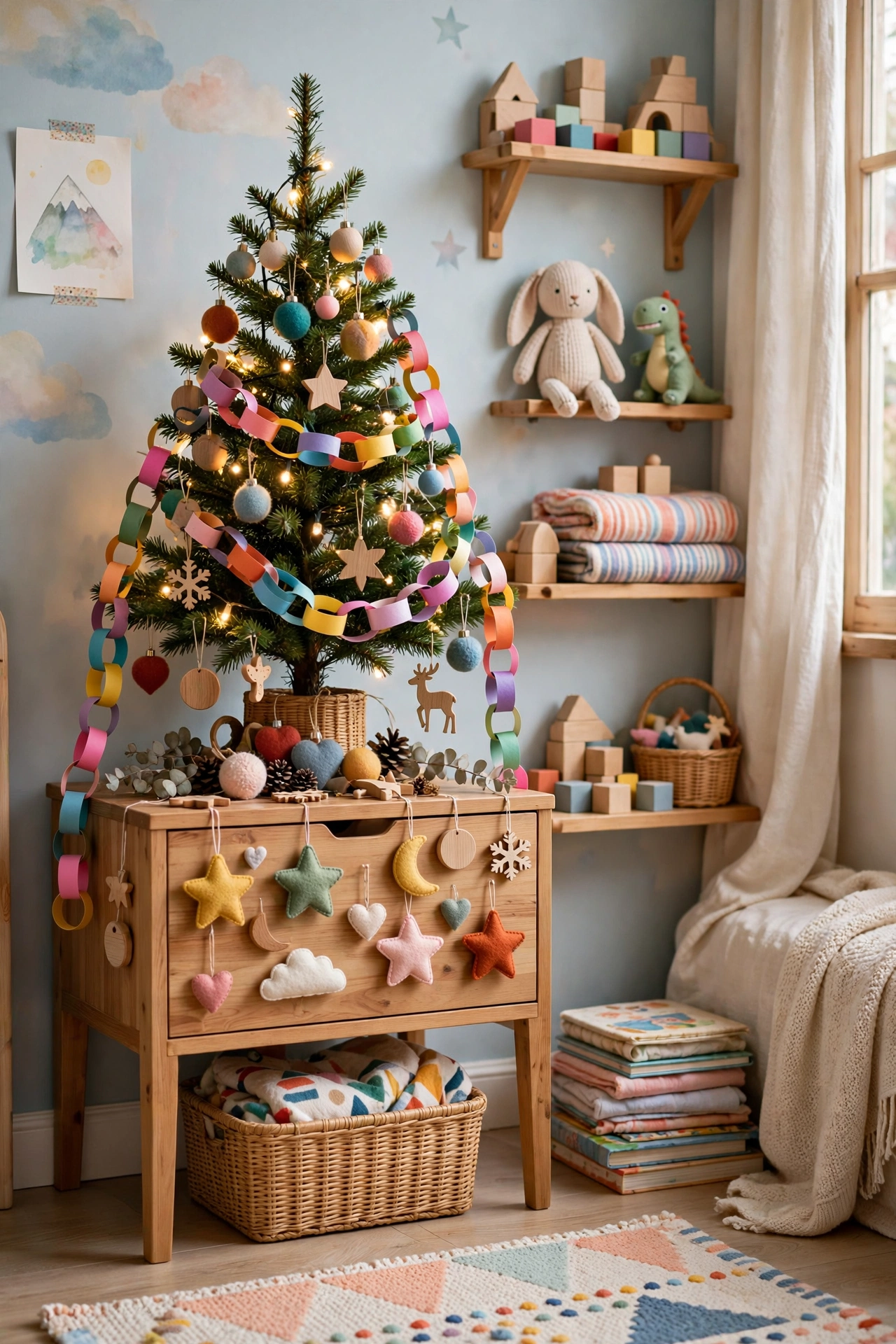
A child’s tree should be fun, safe, and theirs to decorate. Use a small tree, 90 to 120 centimetres, with unbreakable ornaments, felt ornaments, wooden ornaments, and paper chains. Let the child choose the colours and hang the ornaments, even if the result is not symmetrical.
Place breakable ornaments high, or leave them off a child’s tree entirely. Secure the tree to a wall or a heavy stand if the child is very young, and use battery lights or lights with a low voltage transformer, so there are no hot bulbs at child height.
9. The minimalist tree
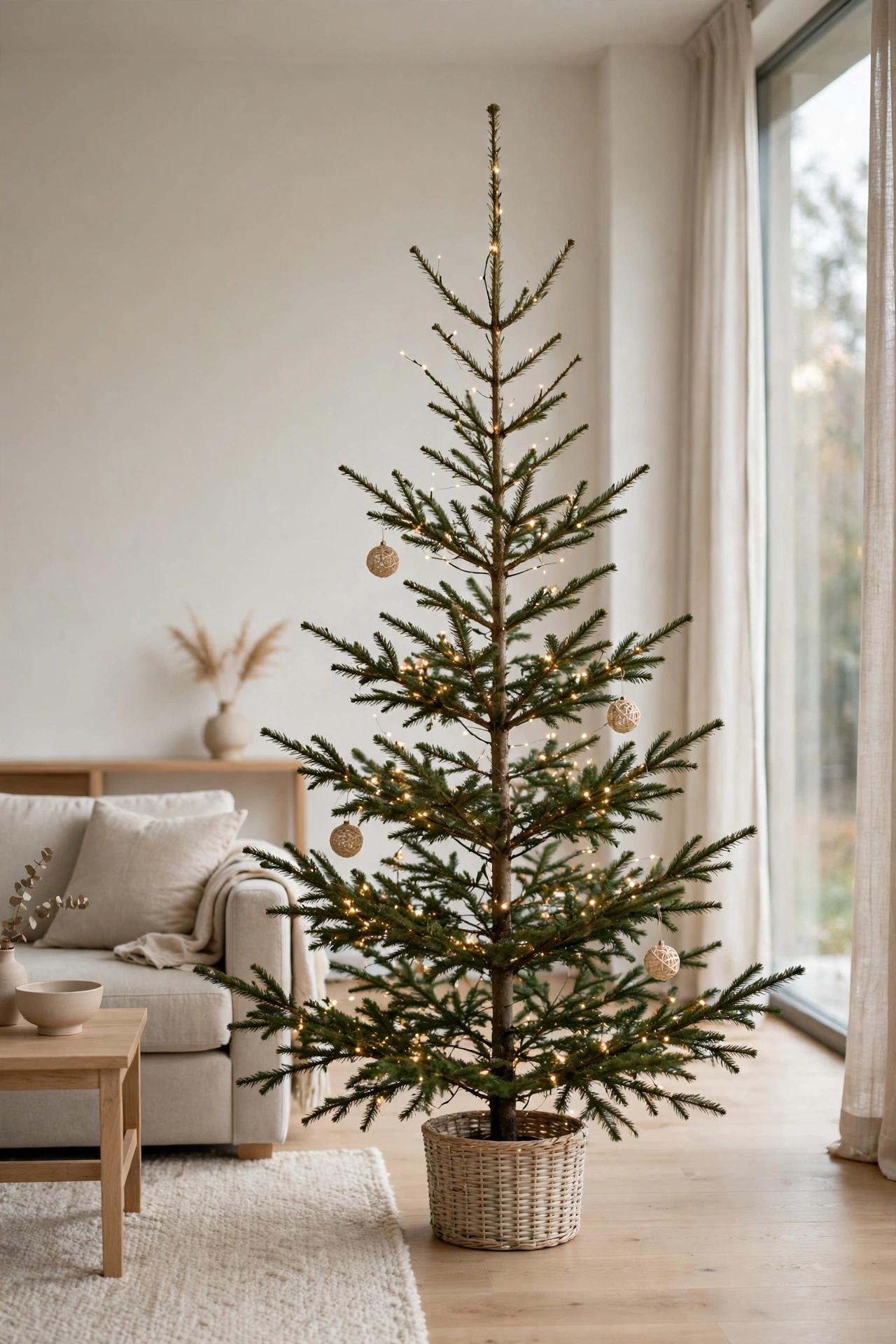
A minimalist tree uses fewer ornaments, one colour, and plenty of empty branch space. Use warm white lights, 20 to 30 ornaments in one colour family, and no ribbon, or one simple ribbon.
This tree suits a modern room, a small room, or a home where the tree is one decoration among many. The key is restraint: if you can see the shape of the tree clearly between ornaments, the minimalist look is working. If the tree looks bare, add lights, not ornaments, because lights fill the tree without cluttering it.
10. The maximalist tree
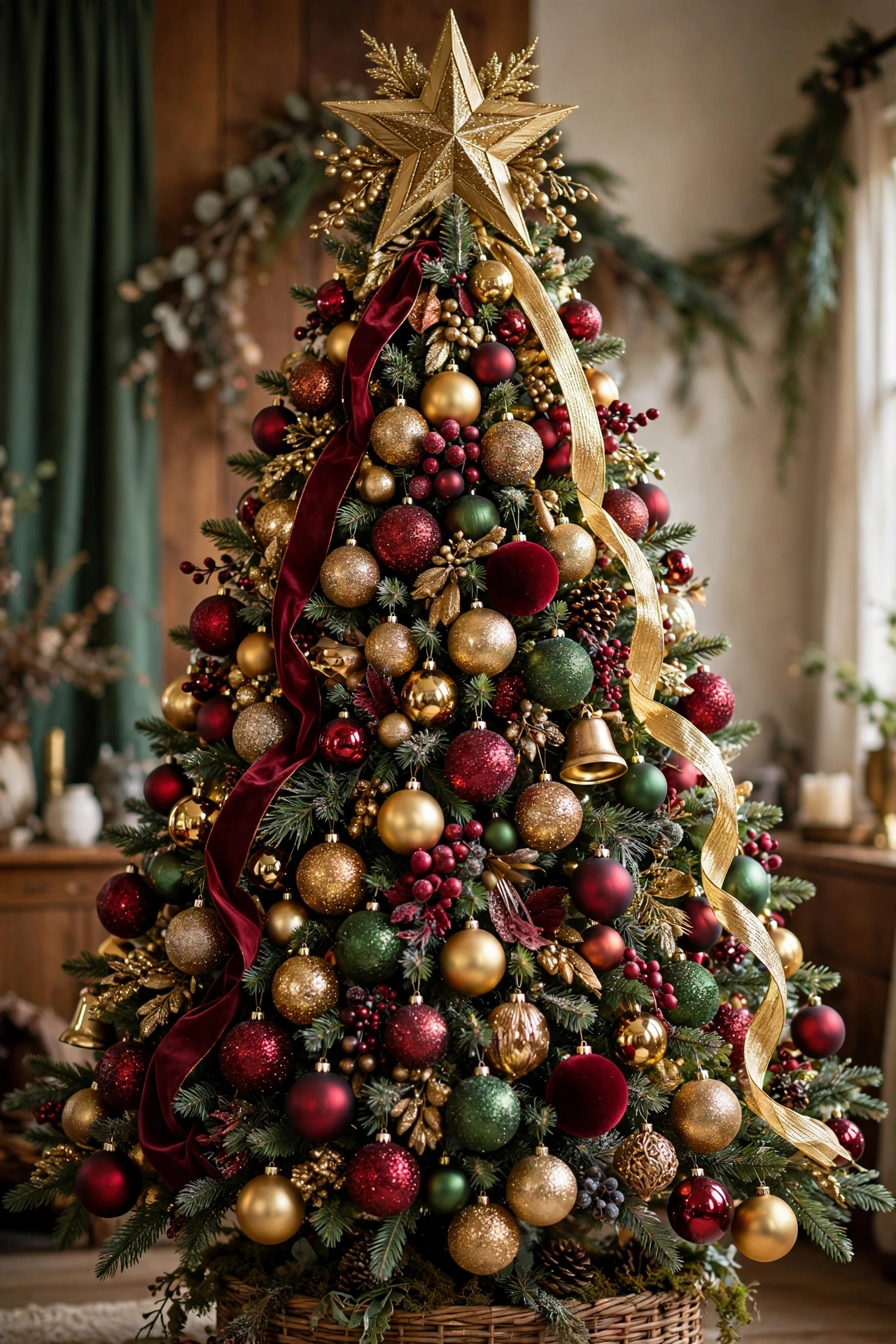
A maximalist tree is the opposite: many ornaments, mixed colours, ribbon, garland, and a large topper. Use 100 to 130 ornaments on a 6 foot tree, ribbon in two colours, and ornaments in at least three finishes, shiny, matte, and glitter.
A maximalist tree needs a clear palette to hold it together, even if the palette is broad. Choose one main colour, one supporting colour, and one accent, and let the ornaments vary inside those colours. Without a palette, a maximalist tree will look like a jumble rather than a celebration.
11. The vintage ornament tree
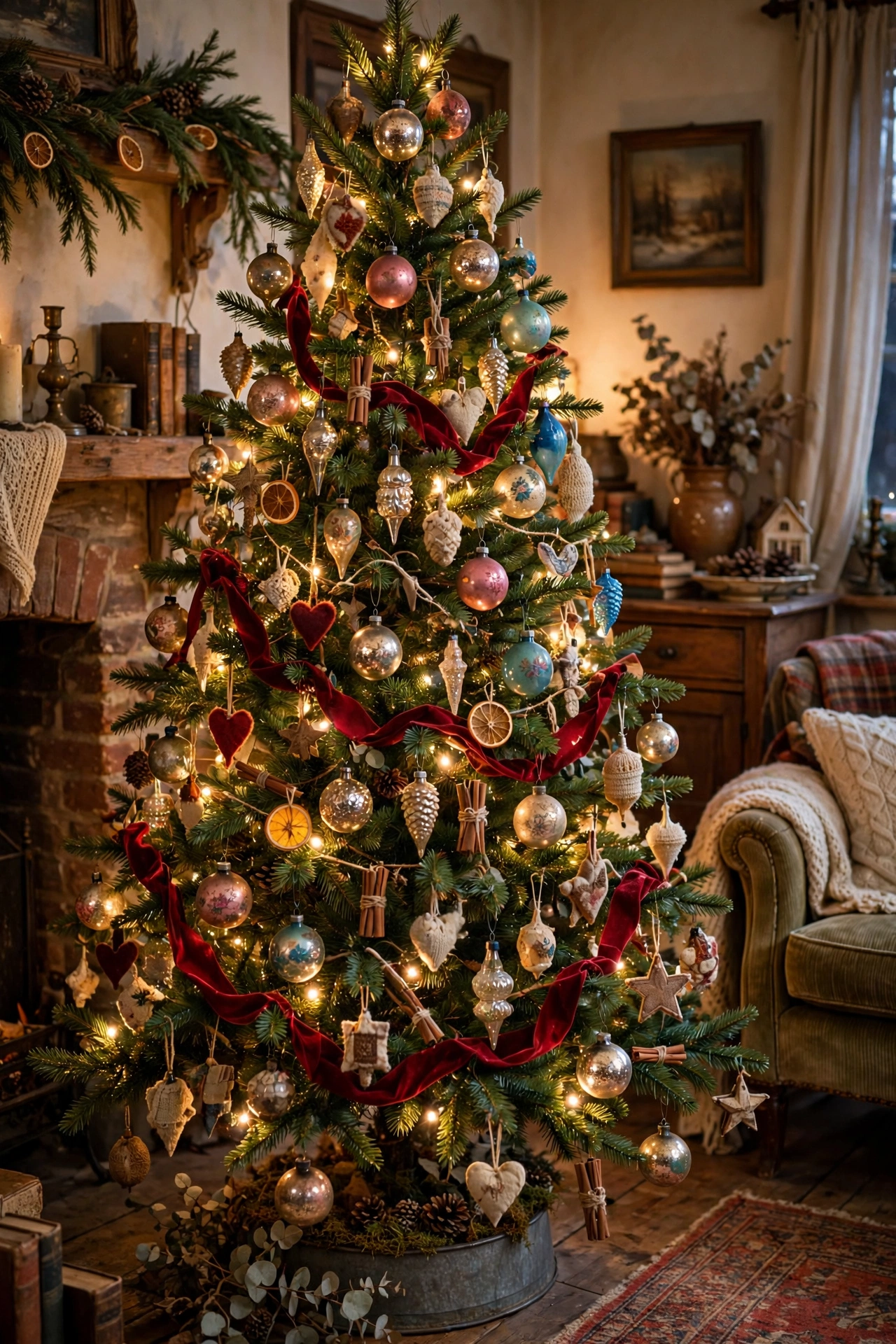
A vintage tree uses collected ornaments, old baubles, family ornaments, and handmade pieces, unified by one ribbon colour. Hang the oldest or most precious ornaments higher, where they are less likely to be knocked, and use new ornaments in the same palette to fill the gaps.
If you have ornaments from different decades, a single ribbon colour, like deep red or gold, will tie them together. Use warm white lights, because cool white lights can make old glass ornaments look harsh.
12. The ribbon tree
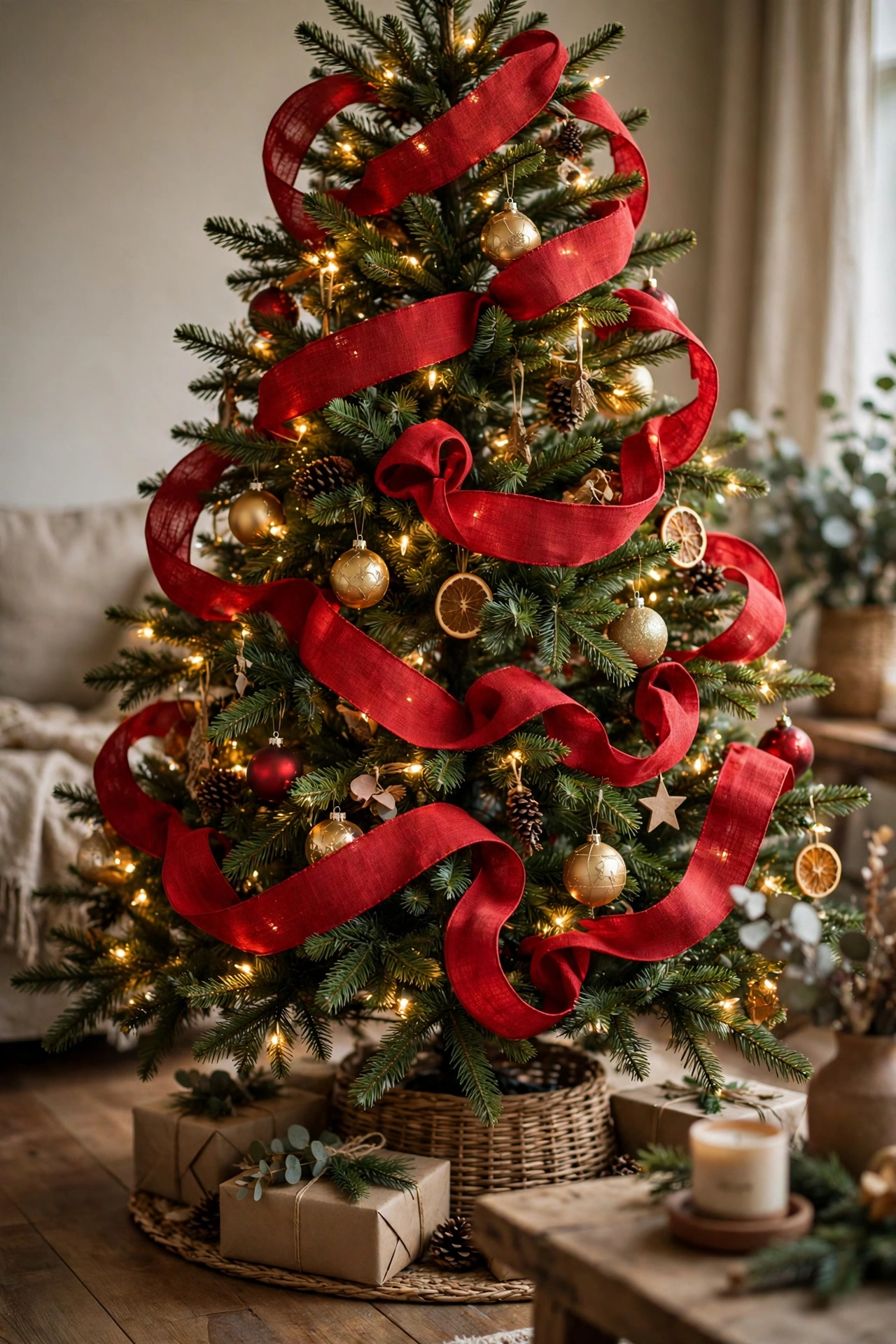
Ribbon is one of the strongest tree tools, because it adds colour and movement in large, simple shapes. Cut ribbon into lengths of 60 to 90 centimetres, about 2 to 3 feet, rather than wrapping one long piece around the tree. Tuck each length into the branches in a loose loop, so it looks like it is flowing.
Use a ribbon width of 3.8 to 6.3 centimetres for a 6 foot tree, and a narrower ribbon for a tabletop tree. For a 6 foot tree, 6 to 8 lengths are usually enough. Too much ribbon hides the ornaments, so stop when you can still see the lights clearly between ribbons.
13. The tree with a garland, not just ribbon
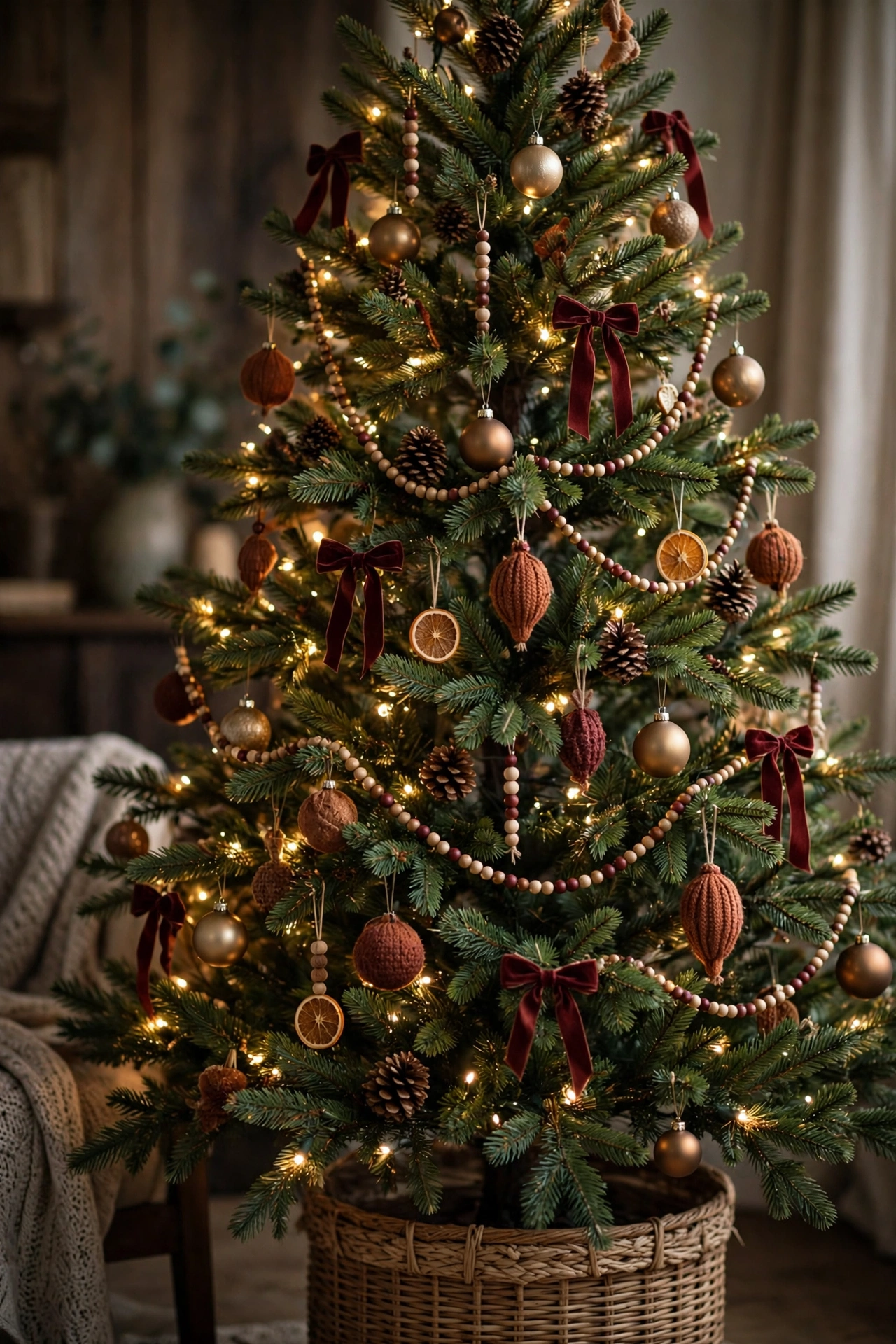
A beaded garland, a felt ball garland, or a simple paper garland adds a different texture to a tree. Drape it loosely from branch to branch, in a gentle swag, rather than wrapping it tight around the tree.
Use one garland, not two, and keep it in the same palette as the ornaments. A garland that is a different colour from everything else will look like an afterthought, while a garland in the palette colour will look like part of the design.
14. The tree by the window
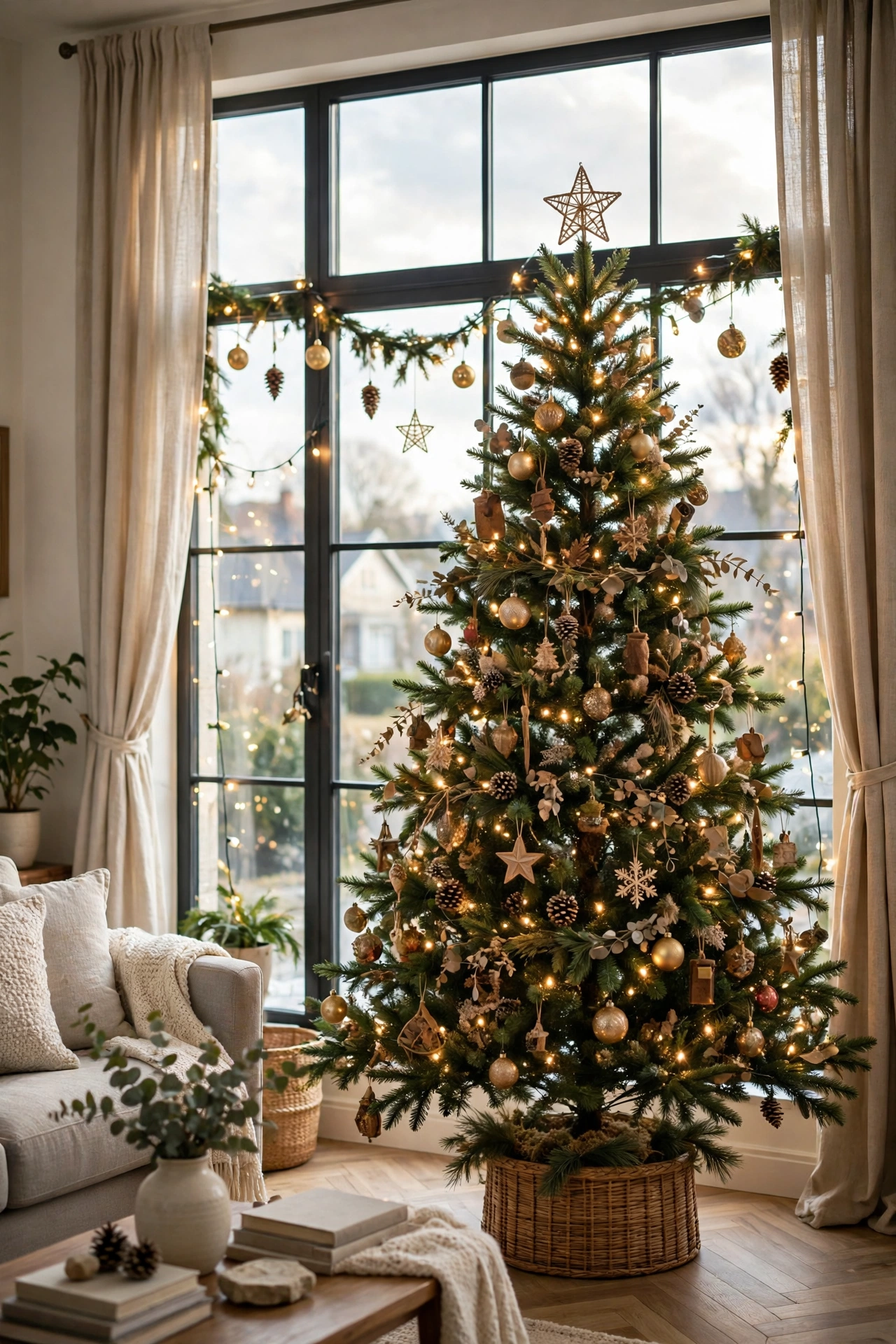
A tree by a window is beautiful from outside as well as inside, and it makes the most of natural light in the daytime. Place the tree where it can be seen from the street, but where it does not block the walkway or the curtains.
Decorate the window side of the tree as carefully as the room side, because neighbours and passers by will see it. Use lights on the window side too, and check the tree from outside at night, to see if there are dark patches that are not visible from inside.
15. The tree in a basket or a large pot
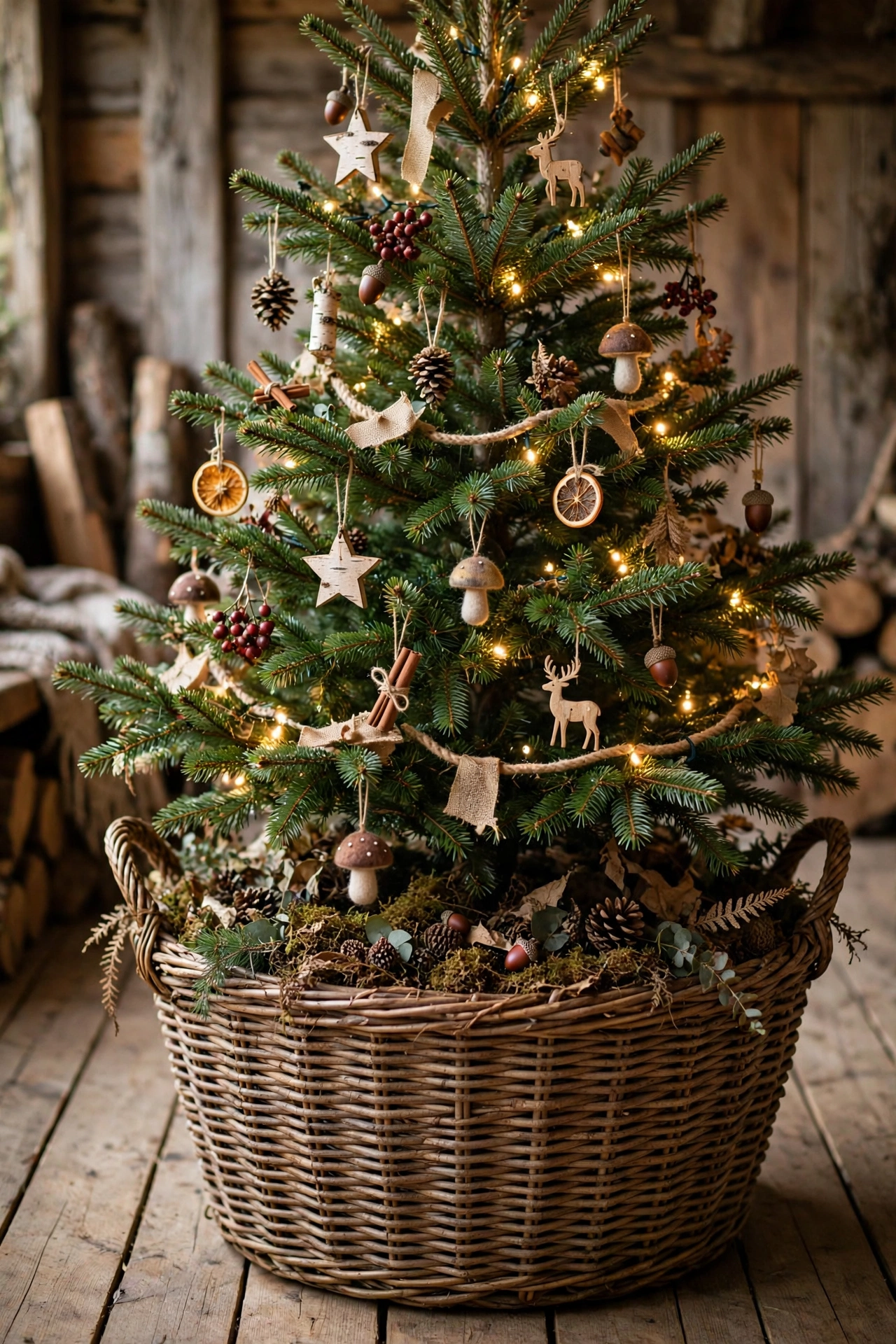
A tree in a large basket, a wooden crate, or a ceramic pot looks more finished than a tree on a bare stand, and it hides the stand completely. Choose a basket or a pot at least 35 to 40 centimetres across for a 6 foot tree, and weigh it down with a heavy stand inside, so the tree cannot tip.
A basket suits a woodland or rustic tree, a ceramic pot suits a classic or minimalist tree, and a metal bucket suits a modern or industrial room. Add a tree skirt inside the basket if there is a gap, so you cannot see the stand.
16. The upside down tree, for a small space
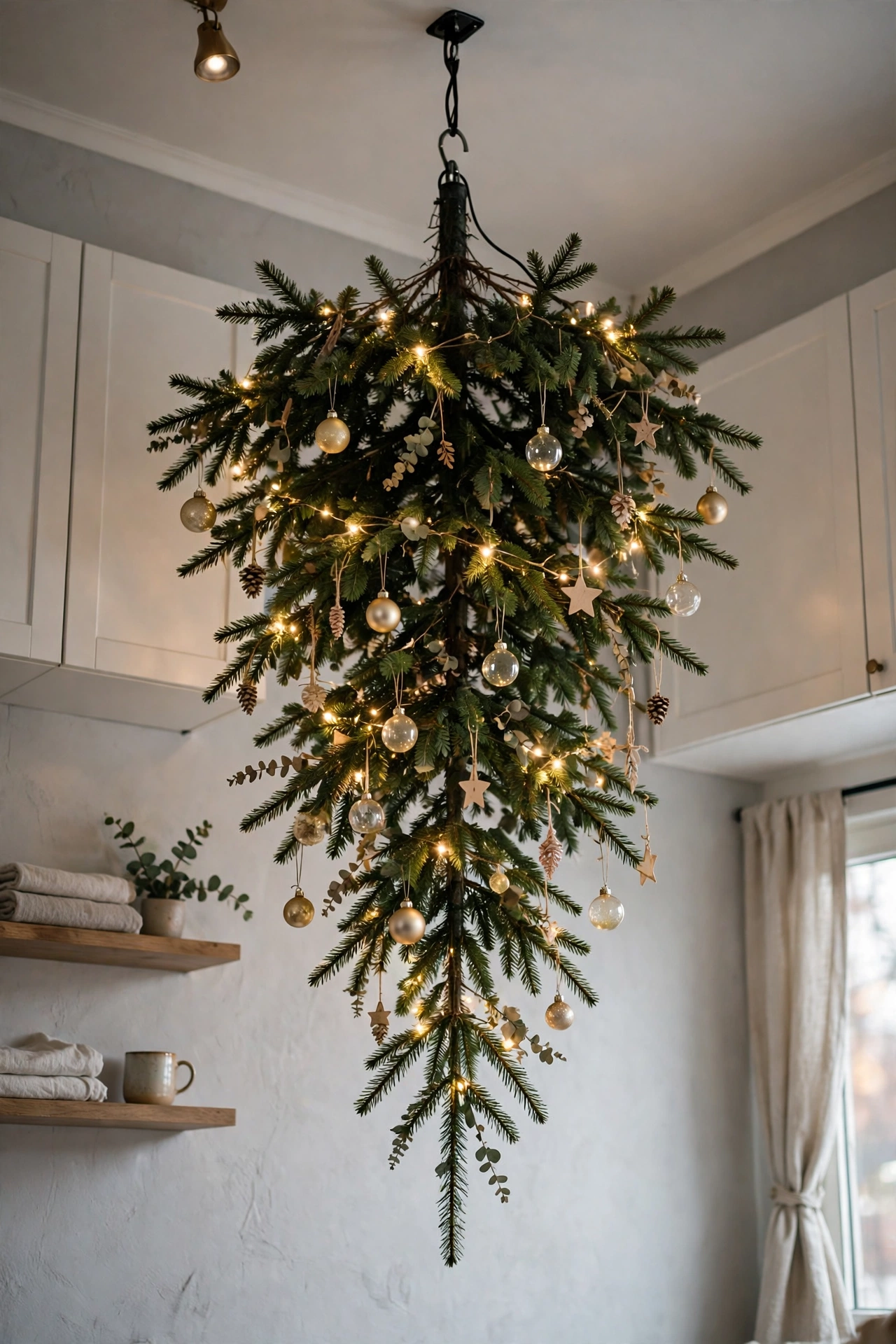
An upside down tree hangs from the ceiling or stands on a special stand with the tip at the bottom. It is a novelty, but it has a practical use: it takes up no floor space, and it keeps ornaments out of reach of small children and pets.
If you try an upside down tree, secure it properly, because a falling tree is dangerous. Use lightweight ornaments, and check that the fixing can hold the weight of the tree plus the ornaments. This tree suits a small flat or a shop window better than a family living room.
17. The tree with dried oranges and cinnamon
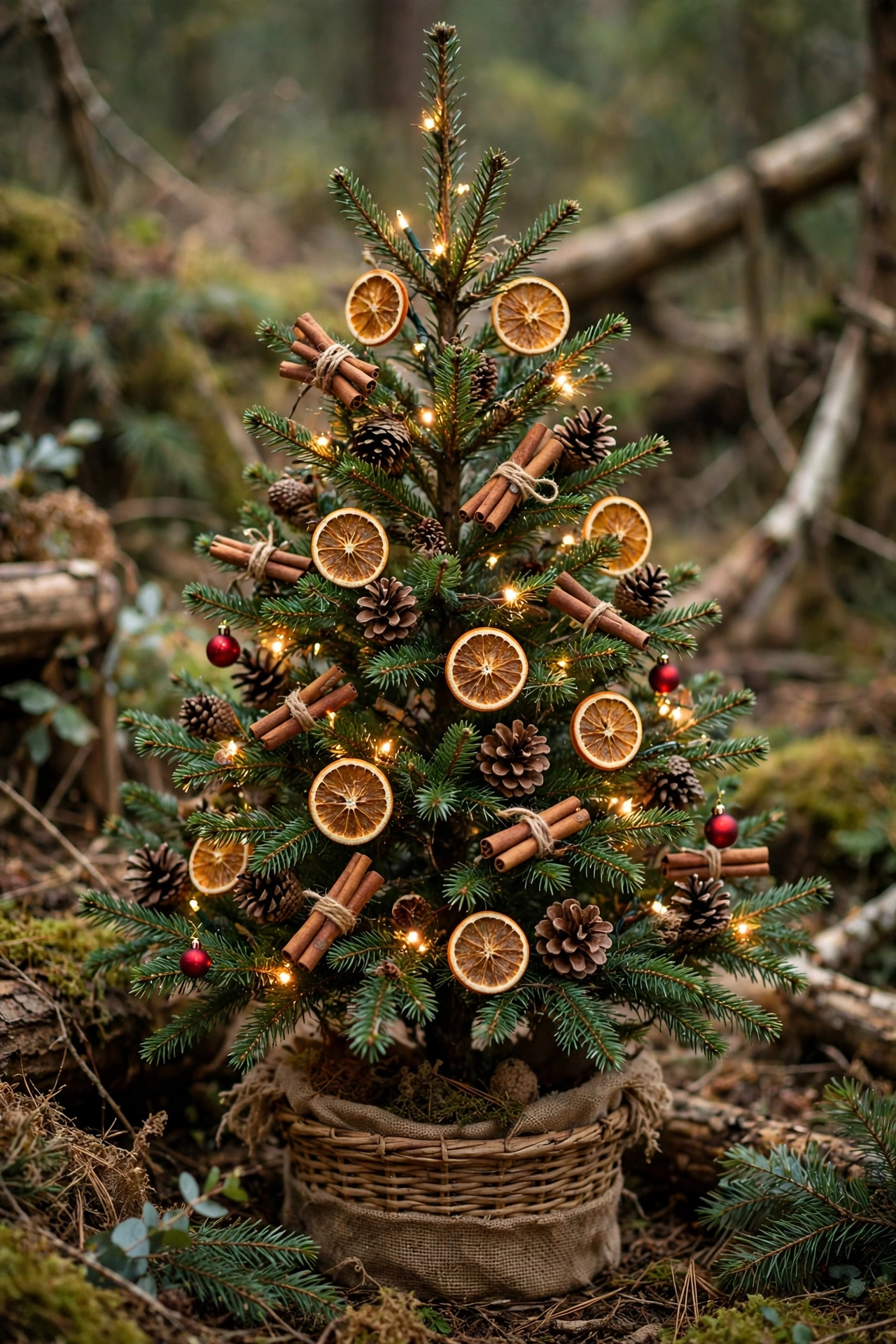
Dried orange slices, cinnamon sticks, and pinecones are low cost, natural decorations that smell wonderful and suit a woodland or classic tree. Dry orange slices in a low oven until they are firm, thread them with string, and hang them between ornaments.
Keep dried oranges and cinnamon away from open flames, and replace them each year, because they will fade and lose their scent. Use them as an accent, not as the only decoration, so the tree still has baubles and lights to give it sparkle.
18. The monochrome tree
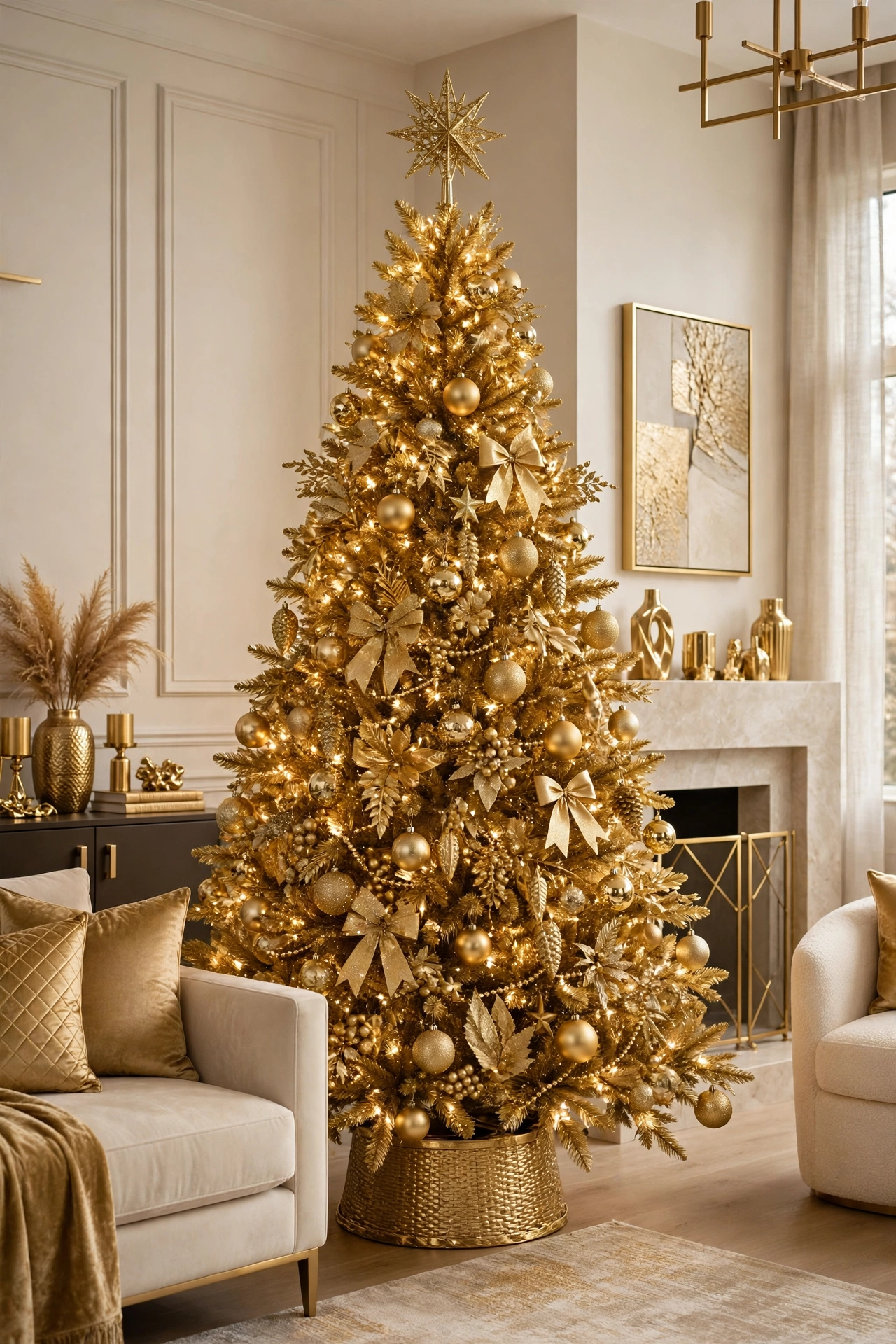
A monochrome tree uses one colour in different shades, such as all gold, all silver, all white, or all deep green. Use ornaments in shiny, matte, and glitter finishes in that one colour, so the tree has texture even though it has only one colour.
A monochrome tree suits a modern room, a formal dining room, or a home where the rest of the Christmas decor is also in one colour. Add warm white lights, and a topper in the same colour, so the tree reads as one deliberate statement.
19. The tree for a rental, with no damage
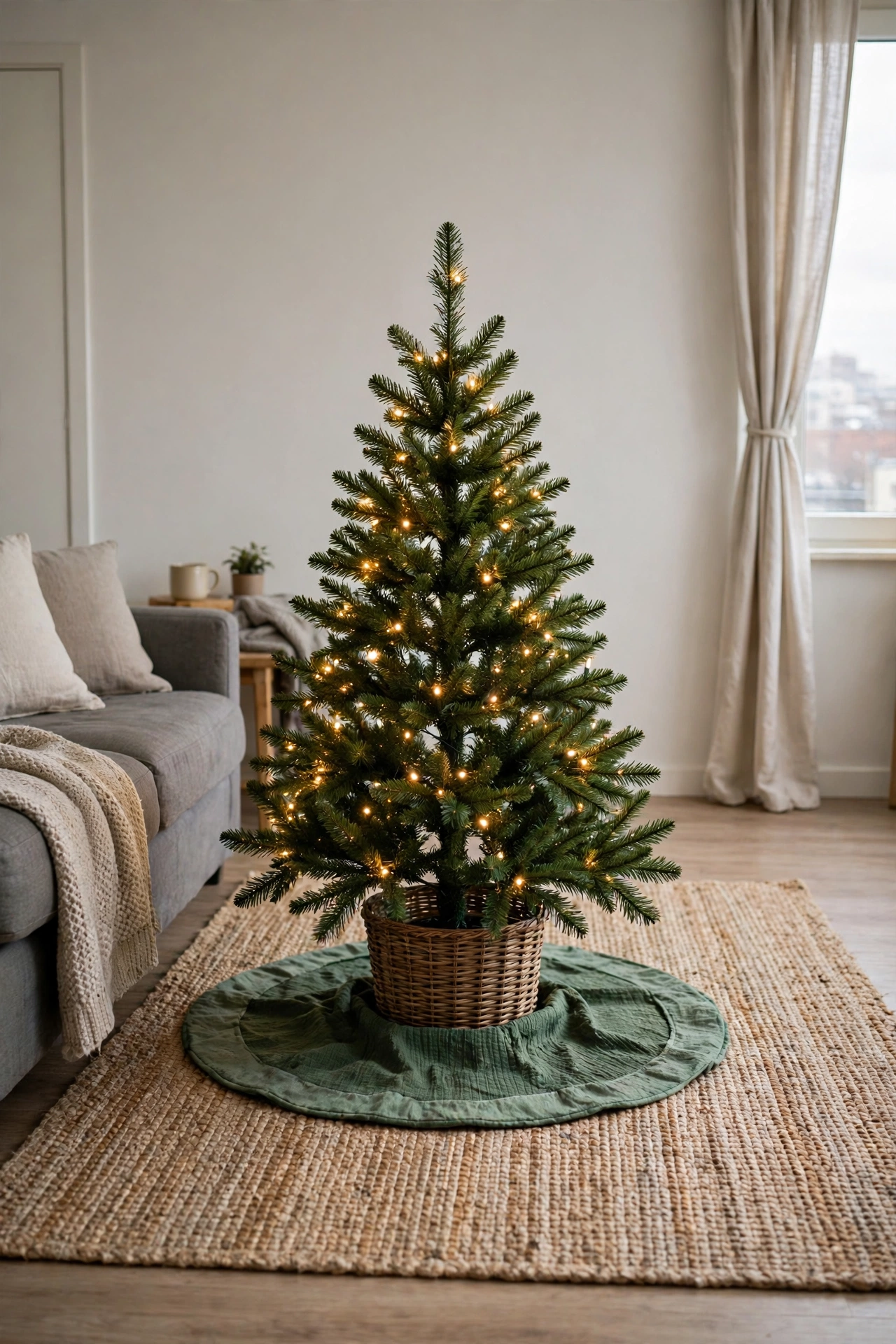
A rental tree should be easy to set up, easy to take down, and kind to the walls and the floor. Use an artificial tree in a basket, so you do not need to fix anything to the wall, and use a tree skirt or a large mat under the tree to protect the floor from water or needles.
Use removable hooks for any garland on the wall near the tree, and battery lights if there is no socket nearby. A tabletop tree is the safest rental tree, because it needs no floor space and no fixings at all.
20. The second tree, for a bedroom or kitchen
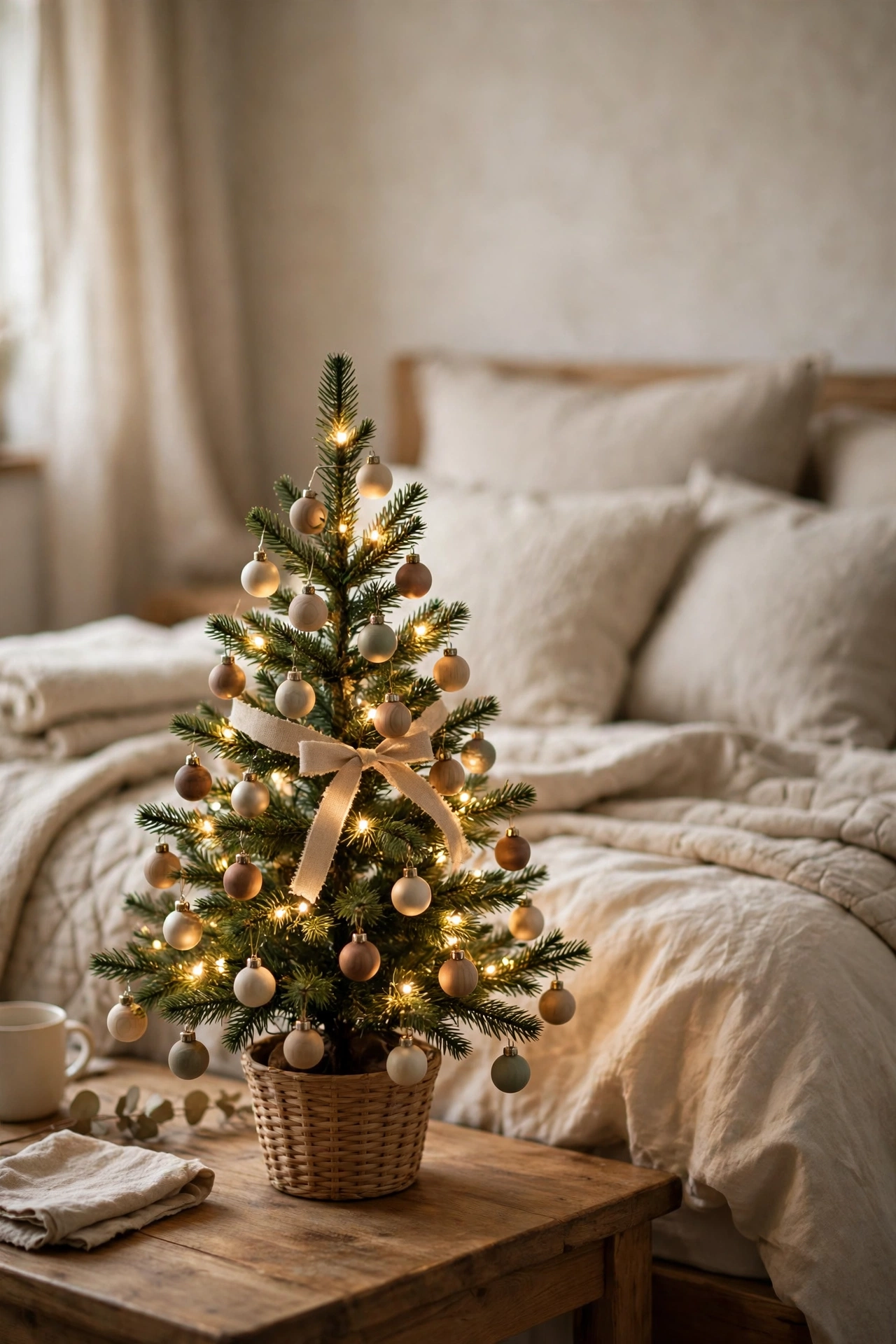
A second tree is a luxury, but a small one in a bedroom or a kitchen can make those rooms feel festive without a large tree. Use a tabletop tree, 60 to 90 centimetres, with a simple palette that matches the room, and 20 to 30 ornaments.
Keep the second tree simpler than the main tree, with fewer ornaments and one ribbon or garland, so it feels like a echo of the main tree, not a competition with it.
The decorating order that saves time
Decorate in this order, and step back after each stage to check from the doorway, not just from close up.
- Place the tree and the skirt or basket, and check the height, the floor space, and the walkway.
- Add lights, starting at the base, working inside the branches as well as on the tips, and checking for dark patches.
- Add ribbon or garland, in loose loops or gentle swags, and stop when you can still see the lights.
- Add ornaments, large ones lower and toward the outside, small ones higher and deeper in the branches, in a mix of finishes.
- Add the topper, secured so it does not lean.
- Final check at night, with only the tree lights on, and adjust lights and ornaments, not the palette.
Safety notes for trees, lights, and candles
Check light strings before use, and discard any string with frayed wire, cracked bulbs, or a damaged plug. Do not connect more strings together than the manufacturer allows, and do not run extension cables under rugs or across walkways. Turn lights off when leaving the house and before bed, or use a timer.
For a real tree, water it daily, keep it away from radiators and fireplaces, and remove it promptly when needles start to drop heavily. Secure the tree to a wall or a heavy stand if children or pets will be near it, place breakable ornaments high, and keep small batteries out of reach. Use battery candles near the tree, not real candles, and never place a real candle on or near a tree.
Frequently asked questions
1. How many lights do I need for a Christmas tree?
Use 100 to 150 lights per foot of tree height for a full glow. A 6 foot tree needs 600 to 900 lights, a 4 foot tree needs 400 to 600 lights, and a 7 foot tree needs 700 to 1,050 lights. Place lights inside the branches as well as on the tips, and keep all strings the same colour temperature.
2. How many ornaments do I need for a Christmas tree?
Plan for 70 to 100 ornaments on a 6 foot tree, 30 to 40 on a 4 foot tree, and 100 to 130 on a 7 foot tree. Use a mix of sizes: about half small, about one third medium, and the rest large or statement ornaments. Hang large ornaments lower and toward the outside, and small ornaments higher and deeper in the branches.
3. What size Christmas tree should I buy?
Measure the ceiling height and subtract at least 30 centimetres for the topper and clearance. A 1.8 metre tree suits a standard living room with a 2.4 metre ceiling. Measure the floor space too: a full 1.8 metre tree needs 1.1 to 1.3 metres of diameter at the base, while a slim tree needs 0.8 to 0.9 metres.
4. Should I choose a real or an artificial Christmas tree?
Choose a real tree if you love the scent and the tradition, and you are happy to water it daily and clean up needles. Choose artificial if you want the same tree every year, you have allergies, or you want a slim or flocked tree. Keep a real tree watered and away from heat, and remove it when needles drop heavily.
5. How do I decorate a small Christmas tree so it still looks full?
Use a slim tree or a tabletop tree in the right size for the room, use lights at the full rate of 100 to 150 per foot, and use smaller ornaments in the right number for the height, 30 to 40 for a 4 foot tree. Place lights inside the branches, use a narrow ribbon, and keep the palette to one main colour and one accent, so the small tree looks intentional, not sparse.
Conclusion
A good Christmas tree is a method, not a mystery. Measure the room, choose the size that fits, put the lights on first and in the right number, add ribbon or garland in loose loops, hang ornaments large to small from the outside in, and finish with a topper that does not lean. Choose one palette, repeat it from the tree to the table, and step back after each stage to check from the doorway. Whether your tree is classic red and green, pink and gold, woodland, minimalist, or a small tabletop tree in a flat, the same order works, and the tree will look full, balanced, and festive, without taking a whole weekend to decorate.